Redeemer Presbyterian Church: Good Friday Meditation
The Sixth Word
Later, knowing that all was now completed, and so that the Scripture would be fulfilled, Jesus said, "I am thirsty." A jar of wine vinegar was there, so they soaked a sponge in it, put the sponge on a stalk of the hyssop plant, and lifted it to Jesus' lips. When he had received the drink, Jesus said, "It is finished." With that, he bowed his head and gave up his spirit.
If there’s one Greek word that English speakers need to understand in order to grasp the profundity of Good Friday, it’s the Greek word tetelestai, which means, “It is finished.” Because on a certain Friday afternoon, on that dark and bleak day, some 2000 years ago, one man, in the last moment of his life, would utter this one word--A word that would change the course of history; a word that word complete the task of God. And, again, that’s the word tetelestai, “It is finished.”
But when that word left the mouth of that one man, what did he mean? What, in fact, was finished?
Well, in order to understand this word, we have to put it in context. You see, like looking at a great painting from the renaissance, in order to understand the subject in the foreground, it’s important to understand the background, which gives the subject its context. So, what’s the background that will bring this word into sharp relief?
Well, the background is the opening chapters of Genesis. You see, John’s Gospel begins with the same words as does the Book of Genesis, “In the beginning.” So, with these words, John is trying to tell us something right off the bat. He’s trying to tell us that his Gospel is going to echo in some way--however slightly--the opening chapters of the Bible. And the opening chapters of the Bible tell us one thing: How God created the heavens and the earth.
You see, the opening chapters of Genesis are structured around the seven days of creation--day one: God creates light; day two: God creates the sky or the heavens; day three: He separates the water from the land; day four: He creates the sun and the moon and the stars; day five: He creates the beasts of the field, the birds of the air and the fish of the sea. And then on day six, before God rests on day seven, Genesis tells us that God created humanity in his own image and crowned them with glory and honor. Then the writer of Genesis tells us that when the creative process was completed, when God looked at his creative work, He said one thing, “It is very good.”
But notice what God didn’t say. He didn’t say, “It is finished.” And John gives us a hint as to why?
You see, not only does John open up his Gospel with the opening words of Genesis--“In the beginning”--but he structures his entire account around seven statements too: The seven “I am” statements of Jesus.
In chapter 6 of John’s Gospel Jesus says, “I am the bread;” in chapter 8 He says, “I am the light of the world;” in chapter 10 He says, “I am the door;” Also, in chapter 10 Jesus says, “I am the good shepherd;” then, in chapter 11 He says, “I am the resurrection and the life;” then, later in chapter 14 He says, “I am the way and the truth and the life;” and then finally, in chapter 15 Jesus says, “I am the true vine.”
You see, John is doing everything he can to echo the Book of Genesis with the hope that we latch onto one very important thing: Where Genesis tells the story of creation his Gospel tells the story of re-creation--it tells the story of redemption.
So, with Genesis as the backdrop, what does tetelestai mean? What does “It is finished” mean?
Well, it doesn’t mean that God…threw in the towel! It doesn’t mean that God gave up!
It doesn’t mean that God resigned!
You see, what is finished is our vain attempts of redeeming ourselves.
You see, on that certain Friday afternoon, on that dark and bleak day, one man, would utter one word, and that word would set us all free--free from the bondage of trying to redeem ourselves.
Monday, March 24, 2008

Sunday, August 26, 2007
Keeping the Tenth Commandment by "Walking" in the Spirit
Last night I preached a sermon at Redeemer Presbyterian Church of New York City on the Tenth Commandment closing out our summer series on the Ten Commandments. If you'd like to, you can purchase it here.
What follows is an abbreviated intro and the outline:
Intro
We may think that the Tenth Commandment is the least important of the Ten and/or it may be the one we least understand. We may think it's the least important because it's the last in the list of the Ten. So we think to ourselves, if it's the last in the list, then it must me the least important. But the Tenth Commandment may be the second most important simply because it is the tenth; simply because it one of the bookends of the Ten.
But also, it may be the one we least understand because we've become completely desensitized to its meaning. Think of all the synonyms for the word covet: desire, envy, crave, yearn. Every one of these words has a perfume named after it. So we have Desire by Dunhill; Envy by Gucci; Crave by Calvin Klein; and, Yearn by Victoria's Secret. Therefore, our culture has done a good job of desensitizing us to its meaning.
So, let's figure out what this commandment means by looking at it under three headings. Let's look at:
1. What It Is (let's define it)
2. What It Leads To
3. How It Can Be Kept
Tuesday, July 17, 2007
The Second Commandment:
A Conversion of the Imagination
I recently preached a sermon on the second commandment at Redeemer Presbyterian Church entitled, A Conversion of the Imagination, which you can purchase here. I then re-preached it at the Village Church (which is a church plant of Redeemer) and you can listen to it free here.
The three points were as follows:
1. The Purpose of the Imagination
Since humans are created in God's image and are vice-regents, God's under-kings, the use of the imagination is a good thing, and quite honestly, a very human thing to do. We are to use our imaginations to envison a world where shalom is the norm. And we're to rule over the created order. That's what "kings" do!
2. The Problem with the Imagination
But, ever since the fall, we misuse our imaginations and envision God wrongly. We either imagine him as something we're suppose to rule over, ("the fish our the sea, the birds of the air or every living creature that moves along the ground"), or, we imagine him to be just like us. So, what we need is...
3. A Conversion of the Imagination
Ever since the beginning of time, ever since the creation of the world, God has always known how he'd want to be imagined: "Jesus Christ is the image of the invisible God, the first born over all creation." So, to imagine God as he wants to be imagined, to see him in the face of Jesus Christ, is to have our imaginations converted.
Friday, June 15, 2007
The Wishy Washy PCA!
I think that it's about time for me to chime in with my two cents (sorry for the mixed metaphor) on the happenings at the PCA General Assembly. For the most part, I'm discouraged by the outcome and here's the reason why.
The adoption of the FV/NPP study committee's report has and will complicate matters more. It adds another layer of hermeneutical confusion to the discussion. That is to say (and following David Coffin), we already have a Confession to lead us through matters of controversy. We don't need another document thrown in the mix. Moreover, how the document is handled and interpreted (from this point forward) will become a matter of debate in the coming months. Take the first recommendation for example:
"That the General Assembly commend to Ruling and Teaching Elders and their congregations this report of the Ad Interim Committee on NPP, AAT and FV for careful consideration and study" (my italics).
I'm sure you can see where I'm going with this: whose idea of "careful consideration and study" are we following? Some presbyteries and pastors could respond, "We considered it, thank you, but no thank you." Why is this a fair response? (1) Because the document is NOT constitutionally binding; and (2) Because as the study report even reminds us, it is still up to the presbyteries to decipher the document and apply it.
All this document did was make our denominational stance on the issue more WISHY WASHY! We should have followed the lead of Joe Novenson and added a year and exegetical teeth to the paper.
Monday, June 04, 2007
PROLEGOMENA: Redeemer Presbyterian Church
Sunday, June 3, 2007
I like to prepare us for worship this evening by talking a little about love. Now, would it seem odd to you if I told you that my daughter Hannah--who’s only three years old--knows something about love, that you and I have either forgotten or never learned? I mean, if I were to ask you, how much does your husband or wife, or boyfriend or girlfriend, or your mom and dad love you, how would you answer? You’d probably answer like this: “They love me very much;” or “They love me a lot;” or “They love me a great deal;” or you might even say, “They love me with all my heart.” But my daughter Hannah tells me that she loves me “As big as the stars.”
Now, what’s interesting about her answer is that she attaches a spatial significance to love. In other words, she understands the stars as infinitely removed from us here on earth. And the space between us and them, is the amount of love she has for me.
Now, to you or I that may sound a little silly and 3 year-old-ish, but let me suggest that Hannah’s description of love is very similar to the apostle Paul’s.
In Ephesians 3 Paul describes the love of Christ in this way: “And I pray that you, being rooted and established in love, may have power, together with all the saints, to grasp how wide and long and high and deep is the love of Christ.”
So, are you ready to worship the God who loves you, to quote my daughter Hannah, “As big as the stars?” Welcome to worship!
Monday, May 07, 2007
PROLEGOMENA: Redeemer Presbyterian Church
Sunday, May 6, 2007
I’d like to prepare us for worship this morning by turning your attention to one sentence in the reflection quote printed on page 1 of your bulletin. In the middle of the quote we read, “The cross reminds us that we too were enemies whose hostility and offence have been reconciled.”
Now, this week I attended a lecture at Princeton Theolocial Seminary given by Stanley Hauerwas--a theologian and ethicist at Duke University. And during the Q & A, Hauerwas was asked about heaven--about what the future would be like when we’re with God. And his answer was simple, yet surprising. He said something like this: “Heaven will be about our restored friendship with God.”
Now, to some of you that may sound overly simplistic and/or reductionistic. But at bottom I think Hauerwas is right. Because both the reflection quote and Hauerwas are picking up on a thought of Paul in Romans 5 which reads, “For if while we were enemies, we were reconciled to God through the death of his Son, much more surely, having been reconciled, will we be saved by his life.”
You see, the God we come to worship this morning; the God we come to sing praises to, has done something special for us: He’s allowed for us to befriend Him again. And that happened the moment Jesus died; the moment he gave up his friendship with God so we can have a friendship with God once again.
So, are you ready to worship God our friend this morning? Welcome to worship!
Friday, April 27, 2007
The Straw That Broke the Camel's Back:
Why I Switched to the NRSV
Beyond the fact that most noteworthy scholars today use the NRSV, I've got my own reasons too. Here's one:
Everyone has their theological pet-peeves. One of mine is paedo-baptism. I guess you can say that I'm just a good presbyterian working out his covenant theology to its rightful (logical) conclusion.
So, when I was counseling a diaconate candidate out of my NIV--a candiate who was struggling with paedo-baptism--and turned to Acts 16 where Paul baptizes the Philippian jailer's entire household (oikos) based on his belief, and saw that the NIV took the liberty of changing the pronoun to a plural (his to their faith, pepisteukos), and also found that there weren't any text-critical issues to speak of, well, that was "the straw that broke the camel's back." I picked up my leather-bound NRSV and put it in my backpack and took the NIV and buried it on my shelf. (Even though the NIV's proper place is in the trash, I cannot, for the life of me, chuck a Bible.)
Tuesday, April 17, 2007
Psalm 23: A Fresh Translation in Light of the Exodus Event (Part 1)
-1 A Psalm of David
1 YHWH my shepherd! I lack nothing!
2 He will make me lie down in green pastures;
he will lead me into calm waters;
3 he will restore my life.
He will lead me on the right path
for the sake of his reputation.
4 Even though I (currently) walk through the darkest valley,
I fear no evil,
because you are with me;
your rod and staff--they comfort me.
5 You prepare a table before me in the presence of my enemies;
you anoint my head with oil;
my cup overflows.
6 Surely goodness and loving-kindness will follow me
all the days of my life
and I will dwell in the house of YHWH
my whole life long. (v. 6 follows the LXX)
Monday, April 16, 2007
PROLEGOMENA: Redeemer Presbyterian Church
Sunday, April 15, 2007
Well, just in case you forgot (or wanted to forget) what today is, I’m going to remind you: Today is April 15th. And we all know what April 15th is, right? It’s the day that Jackie Robinson played his first Major League baseball game, 60 years ago, in 1947, in the borough that Rev. Matt Brown says God loves: in Brooklyn! And on that day something special happened: People who were once separated, were now brought together; something that was once exclusive, now included all; and, the barrier that once divided, was now brought down. Sound familiar? Well, if not, then let me remind you of these words from the apostle Paul.
In Galatians 3 Paul writes: “There is no longer Jew or Greek; there is no longer slave or free; there is no longer male and female, for all of you are one in Christ Jesus.”
You see, the God we come to worship this morning, the God we come to sing praises to, has made a way for all people, all people everywhere, to worship Him as His people. So, are you ready to worship Him this morning as His people, a people that includes all people? Welcome to worship!
Friday, April 06, 2007
Good Friday Meditation 2007: Redeemer Presbyterian Church
Every Good Friday at Redeemer Presbyterian Church in NYC, we host four services where we reflect on the death of Jesus Christ with four readings and three meditations--each meditation given by a member of the pastoral staff. In years past, these meditation sought to answer one of the following questions: (1) Why did He come? (2) Who was He? (3) What did He do? This year, however, we changed the format to "Jesus: Our Prophet, Priest and King." The passage that we have chosen to highlight the three offices of Jesus Christ is, Luke 19:37-48 (and then a final reading of Luke 23:44-49 without a reflection, leaving the congregation to reflect of Jesus' death). My meditation is on Luke 19:37-40 and is entitled, "Jesus Our King."
37When he came near the place where the road goes down the Mount of Olives…the whole crowd of disciples…began joyfully…to praise God in loud voices for all the miracles they had seen:
38”Blessed is the king who comes in the name of the Lord!”
“Peace in heaven and glory in the highest!”
39Some of the Pharisees in the crowd said to Jesus, “Teacher, rebuke your disciples!”
40 “I tell you,” he replied, “if they keep quiet, the stones will cry out.”
In the ancient world, especially in Rome, when a king was about to enter the imperial city, the citizens beneath his rule, would have rushed out to meet his procession. This means that thousands of people would gather to celebrate the homecoming of their king. And as the king’s procession would draw near the imperial city, the celebration, well, the celebration would grow more and more intense: The cheers would become thunderous; the hands of all the people would be raised in the air; and all those who were present would praise the coming of their king. Yet interestingly, you didn’t have to like the king, or agree with the king to be there to greet him--since not showing up to greet him would demonstrate a great disrespect for the king
There’s a great picture of this in the movie The Gladiator. When Commodus the king--the king that no one cared for and the king that no one respected—well, when he entered the imperial city, thousands of people still turned out to greet him, whether they loved him or not. And I think that’s something like the picture that Luke has painted for us in this passage.
You see, as Jesus entered the holy city, he was met by cheering crowds who recognized him as the coming King. But he was also met by those who weren’t too happy that the celebration was taking place.
Now, if you’re anything like me, when you heard the answer that Jesus gave the Pharisees (those people in the narrative who were less than celebratory and the people who wanted to see the celebration come to an end) well, Jesus’ answer probably through you for a loop. I mean, it probably made you scratch your head and ask yourself, “What do crying stones or shouting rocks have to do with Jesus being the King? Quite honestly, EVERYTHING!
You see, ever since the beginning of time, the world, the cosmos, the universe, recognized its Creator-King. But what’s more, the cosmos always knew, and had little doubt, that there would come a day, a day that would be unlike any other day: The day that all things would be renewed. And that day would be the same day that the universe’s King would take his throne.
You see, today we’re here to celebrate the enthronement of the King. Except this King’s crown would be made of thorns; and this King’s throne, would be nailed to him, and he would hang on it for six long hours. And at the very last moment of this King’s life, the rocks would indeed cry out.
Now, Matthew tells us about that moment at the end of his Gospel where we read this: “And when Jesus had cried out again in a loud voice, he gave up his spirit. And at that moment the curtain of the temple was torn in two from top to bottom. And the earth shook and the rocks split.
You see, at the very moment when the King of the Universe breathed his last breath, the universe, the cosmos, the created realm screamed at the top of its lungs when the earth shook and the rocks split.
Yet somehow I don’t think that those screams were wales of mourning. Instead, I believe that they were the first shouts of joy, the first celebratory cries, as the universe began to realize--at that very moment--that everything was beginning to be set free from its bondage to decay! Amen.
[The artwork on the top left hand corner of the post was used on Redeemer's bulletin for the service. It is entitled, Tetelestai! (It Is Finished!): Charcoal on paper, 2005 (36" x 24"). The artist is my father, Paul Buccheri. It was his gift to me for my ordination and it hangs on my living room wall. My father told me that when he was working on the piece, he kept Isaiah 53:2 in the front of his mind: "He had no beauty or majesty to attract us to him, nothing in his appearance that we should desire him." Yet interestingly, the piece is a loose self-portrait of my father, which in turn, makes it theologically profound: that when Jesus died, so died my father.]
Monday, March 26, 2007
PROLEGOMENA: Redeemer Presbyterian Church
Sunday, March 26, 2007
Good Friday, the day that Christians celebrate, or we might even say, mourn the death of Jesus Christ, well that day is fast approaching. And like most churches around the world, Redeemer will have a Good Friday service. And not just one service, but four: Two on the Eastside and two on the Westside. Now, many of us will come to those services; and we’ll come to those services straight from work, dressed in our business suits, sporting Brooks Brothers, Prada, and your Gucci attire. Yet strangely enough, all of us, because of what we’re wearing, will be, in some sense, out of sync with the reality of Good Friday when we walk in the door. Because the essence of Good Friday is about something quite the opposite of the way we’ll look as we enter those services. You see, in John 19 we overhear this conversation about the reality of Good Friday:
"When the soldiers crucified Jesus, they took his clothes, dividing them into four shares, one for each of them, with the undergarment remaining. This garment was seamless, woven in one piece from top to bottom. 'Let's not tear it,' they said to one another. 'Let's decide by lot who will get it.' This happened that the scripture might be fulfilled which said, 'They divided my garments among them and cast lots for my clothing.' So this is what the soldiers did."
You see, the God we come to worship this morning; the God we come to sing praises to, was stripped naked! Was completely exposed! Was laid bare! in order to cloth us with something far beyond Brooks Brothers and Prada. He was striped naked to clothe us in His righteousness itself! So, are you ready to worship this God this morning? Welcome to worship!
Monday, February 26, 2007
Promises, Promises! (Part 2)
If there's one thing that the "post-liberals" are good for, it's getting sound-bites from them. I mean, they know how to take difficult topics and condense them into poetic paragraphs that conjure up image after image after image. Consider these words by Walter Brueggemann from his book The Land:
"Place is space that has historical meanings, where some things have happened that are now remembered and that provide continuity and identity across generations. Place is space in which important words have been spoken that have established identity, defined vocation, and envisioned destiny. Place is space in which vows have been exchanged, promises have been made, and demands have been issued. Place is indeed a protest against the unpromising pursuit of space. It is a declaration that our humanness cannot be found in escape, detactment, absence of commitment, and undefined freedom" (The Land, p. 4).
Part 1 of this post dealt with one verse in Paul (Romans 4:13) and the promise given to Abram in Genesis 12. Why, then, Part 2 you might ask? Foolish Sage posted a comment on Part 1 that forced me to further consider the issue (especially in light of the gnostic sentiment of one Reformed systematics professor). Foolish Sage's comment is as follows:
"I spoke with a seminary student just yesterday who was quite upset that her Reformed systematics teacher told her nothing we do for this present world counts for anything, since it is going to be completely destroyed and God is going to create a whole new world."
Again, the understanding beneath this systematics professor's comment is nothing less than gnosticism--that the earth and everything in it is useless (and meaningless) and all that counts are the ahistorical abstract ideas that float above the created realm.
First, the earth is the place where our Lord Jesus Christ was born, died and was raised to new life. It is also the place where YHWH made promises to Abraham, Isaac and Jacob (generation, after generation, after generation, etc.). Thus, Brueggemann's first statement finds support in this very fact: if the earth is good enough for God to live in, it's surely good enough for us as well, and it's surely good enough for Him to redeem. That's good incarnational theology! Second, followers of Jesus are told to go out into the world, making disciples, baptizing them in the name of the Father, Son and Holy Spirit! This lends support to Brueggemann's second point: Christians have a vocation in this world! Lastly, YHWH has said to his people, "I will be your God and you will be my people"...that's a promise! And Jesus said,"I will be with you always, to the very end of the age." Moreover, God's people have been asked to live in a certain way. You know, indicative-imperative stuff. Thus, the statement, "Place is space in which vows have been exchanged, promises have been made, and demands have been issued," is also a true statement about this place called earth.
So, does Christian-gnosticism win out? Not a chance!
Wednesday, February 21, 2007
Promises, Promises! (Part 1)
A comparison reading of Romans 4:13 and Genesis 12:7 show us the eschatological mind of Paul's understanding of the gospel of Jesus Christ. (And when I use the term "the gospel," I mean by it, "the good news about just what the death and resurrection of Jesus the Messiah of Israel affects/renews--individually, corporately, and as we'll soon see, cosmically.)
Romans 4:13 reads, "For the promise that he would inherit the world did not come to Abraham or to his descendants through the law but through the righteousness of faith" (NRSV).
And...
Genesis 12:7 reads, "Then the LORD appeared to Abram, and said, 'To your offspring I will give this land'" (NRSV).
All that YHWH promised Abram in Gensis 12 was the "land of Canaan." Now, I don't know of a scholar who would say that the use of ha erats (the land) in the book of Genesis (particularly this verse in Gen 12) should be understood as "the entire earth," (cf. Walter Breuggemann's, The Land). What makes reading ha erats "globally" in Genesis 12:4 more difficult is that Abram is standing on the threshold of Canaan--a single plot of land in the Ancient Near East.
But of course Paul blows the doors off what all ancient commentators (both Jewish and Christian) believed about this passage. Paul's use of ho cosmos (the world) in Romans 4 goes far beyond the literal, physical earth. Moreover, it goes far, far beyond the promise given to Abram in Genesis 12. Paul now sees the gospel as an affectual and renewing means of "the entire cosmos!" Furthermore, Paul sees the gift as something far beyond Canaan, which is far beyond the original garden-gift to Adam. Paul would have said that Abram, Moses, David and every Jewish commentator (especailly Rabbinic) thereafter were extremely short-sighted! Why? Paul coundn't help but recognize the eschatological implications of the gospel. In Paul's mind, the gospel was nothing less than cosmic in it's scope (cf. Colossian 1).
Monday, January 29, 2007
"Slipping in the Back Door"
(Some Random Thoughts on the Siouxland Presbytery Report)
The Siouxlands Presbytery of the PCA recently adopted a report by a study committee it had erected to deal with the so-called New Perspective on Paul, the so-called Federal Vision and Norman Shepherd's theology. Now, whether or not I agree with (all of some of) its findings is besides the point. The point of this post is to highlight a few random thoughts.
1. At a time when a lot ministers in the PCA are becoming increasingly frustrated with the denomination's current trajectory--a trajectory that is anti-ecumenical and increasingly uncharitable--and a few churches have withdrawn from the denomination, I'm thankful that the PCA is the kind of place that allows each presbytery the freedom to decide matters like these on their own. Moreover, the Siouxlands Presbytery document carries little if no weight in other presbyteries and in the denomination as a whole (thankfully!).
2. The document itself is far from nuanced. The conclusion reads: "The proponents of these views are outside the system of doctrine of the Westminster standards and do contradict the Scriptural teaching."
Therefore...
3. I believe that the good majority of people who are gearing up to fight this particular battle also support (or have supported) strict subscription to the Westminster Standards in the denomination. Therefore, it's another way of getting at the issue of strict subscription adherence (or the need for strict subscription adherence) to the Standards. In other words, I believe that the argument for strict subscription adherence to the Standards is trying to slip into the back door and has found a way to piggyback itself on this issue.
Saturday, January 27, 2007

Echoes of Jonah in the Jesus Story
Whether or not the Book of Jonah is historically accurate is not the point of this post. The Gospel writers (Matthew and Luke) make it clear that they knew the story and read the story and used it typologically for Jesus (they even put it in Jesus' mouth). But there are a few other interesting connections between Jesus and the story of Jonah that the Gospel writers pick up on:
1. Matthew picks up on the obvious connection: Jesus' death stay is 3 days long, just as Jonah's encapsulation in the gut of the fish in the depths of the sea (what the writer of Jonah equates with Sheol--the place of the dead) was 3 days long.
2. Luke is more subtle and doesn't mention the 3 day parallel: He hints at the 40 day post resurrection account. Both Jonah and Jesus have a 40 day post resurrection occurrence.
3. In the famous Jesus Stills the Storm pericope, all three synoptic writers have Jesus sleeping in the boat just as the storm begins to rage, threatening to drown the disciples. This is an uncanny parallel with the Jonah story: Jonah was sleeping in the boat as the storm began to rage threatening to drown the newfound YHWH fearing sailors.
Thursday, January 11, 2007

New Years Eve Reflection on Genesis 3: "The King Has No Clothes"
I recently preached a sermon on Genesis 3 through the lens of what Adam and Eve were wearing. You can listen here.
Since my undergraduate art history class, I haven't been able to shake the Masaccio image on the left--an image which perfectly portrays the horror and shame of Adam and Eve's expulsion from the garden. What was branded in my mind was Eve's expression--one which should be on the face of every human being once we have come to the realization that we have been exiled from the presence of the God of the universe.
Tuesday, April 04, 2006

Philippians 1:15-18 and The New York Times Best Sellers
Out of the 71 books listed on the New York Times' Best Sellers lists this past Sunday, 7 of them (nearly 10%) are dealing with Jesus in some way.
Hardcover Fiction: #1 The Di Vinci Code; Hardcover Non-Fiction: #5 Misquoting Jesus; Hardcover Non-Fiction: #12 What Jesus Meant; Paperback Fiction: #14 Angels and Demons; Paperback Non-Fiction: #13 Holy Blood, Holy Grail; Paperback Non-Fiction: #15 The End of Faith; Hardcover "How -To:" #2 The Purpose-Driven Life.
In Philippians 1:15-18 Paul says,
It is true that some preach Christ out of envy and rivalry, but others out of goodwill. The latter do so in love...The former preach Christ out of selfish ambition...But what does it matter? The important thing is that in every way, whether from false motives or true, Christ is preached. And because of this I rejoice.
The question is: Would Paul rejoice after seeing the New York Times Best Seller lists? I believe that he would knowing that the resurrected Lord of the cosmos was being considered by people in some form or another!
Thursday, February 09, 2006
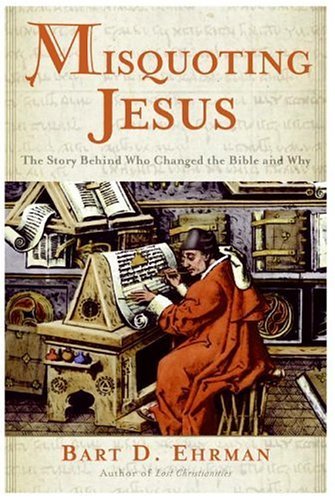
Yes Bart, We Know! (And Have Always Known!)
Bart Ehrman, a NT scholar from North Carolina University, Chapel Hill, has recently published a new book entitled, Misquoting Jesus: The Story Behind Who Changed the Bible and Why. The book--for the most part--is a conglomeration of all the well-known textual critical issues in the NT. The question the book leaves me with at this point in my reading (about half-way through) is: Why did Ehrman write this book?
It seems Ehrman is making another attempt to rattle the evangelical world--to remind evangelicals that the Bible that they read is riddled with "problems." It would be difficult in this brief review to interact with the many textual and transmissional issues that Ehrman touches on. What I can do, however, is (briefly) interact with two thoughts from the back cover.
In Misquoting Jesus Ehrman reveals that:
- The King James Bible was based on corrupted and inferior manuscripts that in many cases do not accurately represent the meaning of the original text.
- The favorite Bible story of Jesus's forgiving the woman caught in adultery (John 8:3-11) doesn't belong in the Bible.
Guess what Bart...we know! We know the KJV and the Textus Receptus are "inferior." We know that John 8:3-11 may be a later gloss and that it's not included in the earliest of manuscripts! My questions is: So what?! Is the way of salvation offered in the gospel obscured by any of this? Not in the least!
My parting comment to Ehrman is for him to read Inspiration and Incarnation: Evangelicals and the Problem of the Old Testament by Peter Enns.
Friday, January 27, 2006
Parting with Tradition
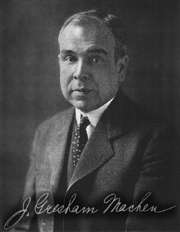
Fundamentalism has greatly--and I mean severely--affected Reformed thinking in America. The Bible--thanks to the fundamentalists--has been reduced to propositional statements about God and most American Christians read their Bibles in an ahistorical fashion. Scholars in this camp have no problem with the study of history per se, but to read the Bible as an historical document is seen as a "liberal" endeavor. But much of the reformed world in America would have no problem allying itself with the great founder of Twentieth-Century reformed thinking, J. Gresham Machen. But what does Machen himself believe?
The student of the New Testament should be primarily an historian. The centre and core of the Bible is history. Everything else that the Bible contains is fitted into an historical framework and leads to an historical climax.
...
Give up history, and you can retain some things. You can retain a belief in God. But philosophical theism has never been a powerful force in the world. You can retain a lofty ethical ideal. But be perfectly clear about one point--you can never retain a gospel. For gospel means 'good news', tidings, information about something that has happened. A gospel independent of history is simply a contradiction in terms.
Could it be any clearer?
Saturday, January 21, 2006
Nick Perrin on Guy Waters in the New WTJ
For those of you who haven't heard, Nick Perrin (Asst. Prof. at Wheaton; formerly at Biblical; and formerly N.T. Wright's research assistant at Westminter Abbey) has just published a book review/critique of Guy Waters' "Justification and the New Perspective."
Perrin is more than fair as he points out Waters' unfairness. He points out that Waters' tone is less than Christian and inflammatory. Here's an excerpt:
First, it goes without saying that the book must be assessed not only for what it says, but for how it says what it says. On this score, even those who are sympathetic to Waters's conclusions would have to concede the book provides an unhelpful model as to how one engages in theological discussion. Inflammatory assertions like, '[I]ronically, it is the ignorance of historical theology on the part of Wright and other scholars that prompts them to make such affirmations...' is simply disrespectful and as such, sub-Christian (1 Peter 3:15-16).
This has always been a major critique of the Reformed critics of the NPP.