No Pepper in the Salt of the PCA!
As I plan to leave for another General Assembly of the PCA, I am reminded of the horror I experienced last year when I walked into the convention hall for the first time. Out of the 1800 or so commissioners on the floor of GA, you could literally count the number of African-American ministers in the denomination.
Now that Redeemer has one of the thirty-three Blacks in the denomination (Rev. Mark Robinson), I have found myself growing more sensitive to this issue. I am looking forward to seeing old friends; I am looking forward to debating the FV/NPP issue; I am NOT, however, looking forward to seeing the lack of diversity in this denomination once again! Therefore, it is my opinion that the PCA has to make a concerted effort to recruit Black ministers in the denomination and get FAR beyond the number 33! Or to put it bluntly: 33 African-American ministers out of roughly 2000 is something we should all be ashamed of! Talk about inequity!
Monday, June 11, 2007

Friday, May 18, 2007
A Brief Open Letter to Moderate TEs and REs in the PCA:
Vote "NO" on the New Perspective and Federal Vision Study Report!
There is little doubt in my mind that the report issued by the PCA's study committee on the New Perspective and Federal Vision attempts to sneak the strict subscription issue in the back door. (And let's not forget that that issue was settled three years ago. We have already decided that we are a "good faith subscription" denomination.) I saw this in the Soiuxland Presbytery commttiee report and I see it here too. Let's not be fooled by this move by the "Far-Right."
VOTE NO!
Monday, May 14, 2007
PROLEGOMENA: Redeemer Presbyterian Church
Sunday, May 13, 2007: Mother's Day
Because it’s Mother’s Day, I’d like for us to reflect on the words of St. Cyprian, who’s obviously the first person that comes to mind for all of us when we think about Mother’s Day, right?
Cyprian was a third century bishop of Carthage in North Africa and he’s most remembered for this one great statement. And that statement is this: “No one can have God as their Father if they don’t also have the church as their Mother.”
You see, Cyprian saw the church as having the qualities of a mother. And we all know that mothers: care, nurture, provide, and protect. So, he saw the church as a care-giver, a nurturer, a provider and a protector And guess what? He was right!
You see, the God we come to worship this morning; the God we come to sing praises to, has decided to “mother” his children--those who believe in his Son--in the church.
So, this morning, are you ready to worship the Father, through the Son, in the church, the one St. Cyprian calls our "Mother?" Welcome to worship!
Monday, April 09, 2007
PROLEGOMENA: Redeemer Presbyterian Church
Easter Sunday, April 8, 2007
This morning, in thousands and thousands of churches around the world, and in every tradition of the Christian faith, Christians will join their voices together to welcome the risen Lord. So, let’s join in the celebration this morning, the celebration of the resurrection of Jesus Christ our Lord. And let’s welcome the Risen One with the words that all Christians, all Christians everywhere, will be saying throughout the world:
Minister: Alleluia! Christ is risen!
All: The Lord is risen indeed! Alleluia!
[The artwork in the upper left hand corner of the post is entitled Lazarus. It was used on the bulletin for Redeemer's Easter Sunday services. The artist is Barbra Februar. She lives in Vancouver, B.C.]
Saturday, March 24, 2007
Sao Paolo, Brazil: The Next Constantinople?
The epicenter of the church has always been in the world's largest cities, ever since the time of Paul. So, just imagine the City of New York, with three times the population, approximately twice the square mileage (NYC: 321; SP: 588), with high-rise buildings as far as the eye can see, only with far less the architectural beauty of Manhattan. That's Sao Paolo, Brazil.
In my previous post, I mentioned that the center of the world Christian movement has and will continue to shift into the global south and east--into cites like Sao Paolo, Mexico City, Shanghai, and Dhaka. As a result of this shift, I challenged us to consider the possibility that the Western church (North America, Europe and England) will need to give up its paternalistic dominance with regard to the future of how the Christian faith is and will be articulated.
Lamin Sanneh at Yale Divinity School in his book Whose Religion is Christianity: The Gospel Beyond the West agrees with this when he writes, "Christianity should not anywhere be about the refusal to change the old; it should be about the willingness to embrace the new."
When the center of the church shifted to Rome from Constantinople and Antioch in the first millennium, the church did not do away with what was previously established. It did, however, continue to address issues in light of the church's new context given the new questions it was asking. All one has to do to confirm this is take a close look at the seven ecumenical councils to see that each council affirmed what was theretofore created and accepted by the preceding councils. For example, the Council of Chalcedon affirmed and built upon the Council of Nicea.
Therefore, the church is faced with a similar situation today. Will it seek to undermine what was established in centuries past? Will it be afraid of the voice from the South and East that is now a whisper but can soon be a scream? If the church was able to weather the storm of the first shift from the South and East to the West, it should, by God's grace, be able to weather the storm back. Thus, places like Sao Paolo will soon be the "Constantinopes" of the Christian World once again.

Thursday, March 01, 2007
The Hermeneutics of Life
Every day we try to make sense of life. And if not just our own lives, then we (especially pastors) try to help others make sense of theirs. It's simply one of the great human (and pastoral) endeavors! It doesn't matter what it is we're dealing with, or what we're trying to sift through, because the fact remains, we're always "dealing" and "sifting." Why? Because we never have all the data! It's just impossible! In other words, we're forced to attempt to make sense of our lives (or the lives of others) with various little bits and pieces of the story. New information is always surfacing; new data is always coming to the fore. Sometimes I think it's a kin to painting by numbers or a jigsaw puzzle--that all we can do is take an educated guess at what the picture is as we put color on the canvas or put another piece in the puzzle.
In Grant R. Osborne's book, The Hermeneutical Spiral, "Osborne contends that hermeneutics is a spiral from text to context--a movement between the horizon of the text and the horizon of the reader that spirals nearer and nearer toward the intended meaning of the text and its significance for today."
Making sense of life's situations is much the same as Osborne's thesis (especially in pastoral counseling). We move between the bits of data we receive and how we understand them, spiraling ever closer to "the truth"--what's really going on; what someone truly needs.
The "hermeneutics of life" can also be compared to viewing a Lichtenstein  painting (since a Lichenstein is nothing other than a collection of dots: To view it properly you'll have to move between getting very close to the canvas and backing off it. If you're too close to the canvas, all you'll notice are large dots that make absolutely no sense; if your too far off, you'll never notice that the painting is a collection of dots. The movement between to two is essential!

Sunday, February 04, 2007
Reformed Sacerdotalism (in Practice)?
Despite the fact that Christians of the Reformed (and broadly Protestant) persuasion insist that they (we) are non- or anti-sacerdotal, a closer look into Reformed (and Protestant) practices will reveal otherwise.
Since the time of the Reformation, most Protestant churches have shifted the aesthetics of their sanctuaries. Roman Catholic churches have always placed the Eucharist at the visual center of the sanctuary. Since the Reformation, however, most Protestants replaced the Eucharist with the pulpit. This had the effect of elevating (both spatially and psychologically) the preaching of the Word over the sacraments. Peter Leithart refers to this as making the sacraments "appendixes" to the preaching of the Word. This has, according to Leithart, forced Protestants to view the Sacraments as "expendable." In Against Christianity Leithart explains:
"So long as baptism and the Supper are seen as "appendixes," they will be seen as expendable. Characterizing baptism and the Supper as "appendixes" to the Word, further, is part and parcel of a Protestant tendency toward the "primacy of the intellect." It is rationalism, in that it reduces baptism and the Supper to a means of communicating information. But that is not what rituals are for."
Generally I agree with Leithart. Protestant churches (including Reformed churches) have not walked away from the Reformation unaffected by Enlightenment categories: The material realm is unnecessary, while the immaterial realm is all we need. "Faith" is all that matters; the ancient practices of the church mean little, if nothing at all. The "noumenal" and the "phenomenal" (to use Kantian terms) cannot interact on any level. (The Apostle Paul was diametrically opposed to this Kantian/Enlightenment/(even) Reformed reality! He saw that the truth of the gospel dispelled this Hellenistic heresy.) But the truth is, Protestant practices reveal something a little different (especially Reformed Protestants!).
While most Protestants will allow their center-stage pulpits to be filled by any Tom, Dick or Harry preacher (even if just once), they WILL NOT allow anyone except a duly ordained minister to preside over the sacraments! In other words, Protestants are sacerdotal in practice as opposed to their rhetoric. Therefore, it's safe to say that Protestant churches (especially Reformed ones) may need to rethink the place (and effect) of their sacramental theology (and the ministers who administer them) in the life of the church based on the fact that we don't preach what we practice!

Thursday, March 02, 2006

Redeemer Times NYC Equals Orthodoxy?
After months and months of phone calls, Michael Luo--the new religion-beat writer for the New York Times--finally hunted down Tim Keller of Redeemer Presbyterian Church and convinced him to cooperate for a front page article in the Sunday Times Metro Section. Most of you might be asking: Why would Keller (or any pastor) disapproave of such exposure? The truth is, Redeemer shies away from the media since it is a church of 4500 and growing.
What might be more interesting than the article itself (an article which I personally found to be a bit flat), is that Luo, an "evangelical" himself, has communicated to the Times that they need to take religion in general and "evangelicals" in particular more seriously. The Times for many years has associated evangelicals with mainstream American fundamentalism, and as a result, mocked this group of readers. But if you can recall, one of the subtexts of the article was to clearly point out Redeemer's discomfort with the term "evangelical" due to all the cultural baggage attached to it, and instead opt for the term "orthodoxy." Personally, I'm more comfortable with the term "orthodoxy" too, since it connects the church at large and Redeemer in particular to the historic Christian church of all times and all places.
Monday, January 23, 2006
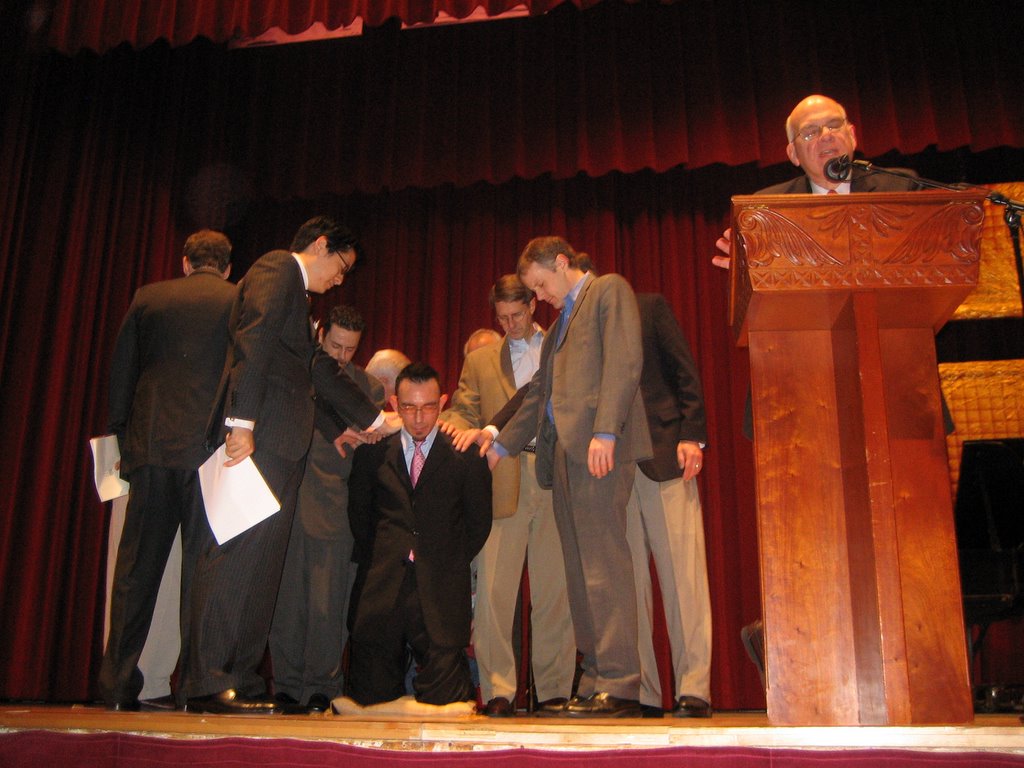
Ordination and Installation of Reverend Matthew Paul Buccheri as Assistant Pastor of Redeemer Presbyterian Church, NYC: January 22, 2006
After looking at this photo, some of you may be filled with disbelief, even with horror. Others, on the other hand--especially those who have supported my ministry efforts over the years--may be celebrating with me. Whatever the case (and whoever you may be), the picture is real and this really happened (regardless of what your opinion may be). By God's grace and after 6 long years of preparation, not to mention "a little help from my friends," I was ordained and installed yesterday morning as an assistant pastor of Redeemer Presbyterian Church, NYC.
I want to take the time to thank some of you who participated in the ordination service: The Rev. John Lin for his winsome opening and preparation that set the tone for the entire service; the Rev. Scott Strickman for his challenging, yet personal charge (Heb 12:2-3); the Rev. Dr. Timothy Keller for his appropriate "ordination prayer;" the Rev. David Bisgrove for our budding friendship; the Rev. Terry Gyger for always believing that I had a place at Redeemer; Webster Younce (elder) for his continued friendship and support (and for agreeing to be the commission secratary); Charlie Oswal (elder) for wearing his Ranger's home jersey at my request. And lastly to Yi Ya my wife and Hannah my daughter--no other two people have supported me more!
Friday, January 20, 2006

Ordination and Installation as Assistant Pastor of Redeemer Presbyterian Church
By God's grace--and it's nothing less--I passed my ordination exams this past Saturday and will be ordained and installed as assiatant pastor of Redeemer Presbyterian Church, NYC on January 22, 2005. As for my ordination exam, all I can say is that it was very fair! And as for my ordination and installation service, Rev. John Lin will be introducing me and reading me my vows; Rev. Scott Strickman will be giving me my charge; and the Rev. Dr. Tim Keller will be praying the ordination prayer itself.
Tuesday, January 27, 2004
The PCA and Urban America
The PCA considers itself to be a churchplanting movement and denomiation. Yet the PCA's history is one that some might label "southern presbyterian" (and southern presbyterianism is a "dirty word" to urbanites since it embodies, espouses and promotes a culture that is foreign to much of this country's urban centers). With the ever increasing urbanization of America (and the world for that matter), how can the PCA continue to plant relavant churches in this country's urban centers?
Harvey Conn and Manuel Ortiz are the churchplanting "gurus" in Reformed-Evangelical circles in the United States. They believe that churchplanting in particular and ministry in general must begin with the indigenous leaders already available within the boundaries of the targeted cities. Conversely, the PCA is (and has been) notorious for raising up leaders steeped in southern-presbyterianism and supplanting them in the urban centers around the country (especially in the north). For Conn and Ortiz this is where the problem begins. Conn and Ortiz make their point extremely clear when they write:
It has been our experience, as well as that of others
with experience in urban ministry and leadership
training, that the kind of leaders necessary for the
task of urban mission already live in the targeted
urban community. To exclude the community as a
resource for selecting and developing leadership is to
exhibit superior and paternalistic attitudes. It
demonstrates lack of respect for the people we hope to
serve. We are long overdue in developing mission
strategies that reflect the fact that leadership for
the present and future of the ministry are already in
the community and that such indigenous leadership is
necessary for healthy and long-term witness. It is
inappropriate, inept and unnecessary to recruit from
outside and impose in a community the leaders we deem
requisite to carry the mission forward, as if there
were no potential leaders in that particular urban
community (Urban Ministry, p. 412-413).
Could it be that Conn and Ortiz are just simply reflecting on, or beginning with, the Pastoral Epistles (especially Titus 1:5)? Why don't we?