Keeping the Tenth Commandment by "Walking" in the Spirit
Last night I preached a sermon at Redeemer Presbyterian Church of New York City on the Tenth Commandment closing out our summer series on the Ten Commandments. If you'd like to, you can purchase it here.
What follows is an abbreviated intro and the outline:
Intro
We may think that the Tenth Commandment is the least important of the Ten and/or it may be the one we least understand. We may think it's the least important because it's the last in the list of the Ten. So we think to ourselves, if it's the last in the list, then it must me the least important. But the Tenth Commandment may be the second most important simply because it is the tenth; simply because it one of the bookends of the Ten.
But also, it may be the one we least understand because we've become completely desensitized to its meaning. Think of all the synonyms for the word covet: desire, envy, crave, yearn. Every one of these words has a perfume named after it. So we have Desire by Dunhill; Envy by Gucci; Crave by Calvin Klein; and, Yearn by Victoria's Secret. Therefore, our culture has done a good job of desensitizing us to its meaning.
So, let's figure out what this commandment means by looking at it under three headings. Let's look at:
1. What It Is (let's define it)
2. What It Leads To
3. How It Can Be Kept
Sunday, August 26, 2007

Friday, May 18, 2007
A Brief Open Letter to Moderate TEs and REs in the PCA:
Vote "NO" on the New Perspective and Federal Vision Study Report!
There is little doubt in my mind that the report issued by the PCA's study committee on the New Perspective and Federal Vision attempts to sneak the strict subscription issue in the back door. (And let's not forget that that issue was settled three years ago. We have already decided that we are a "good faith subscription" denomination.) I saw this in the Soiuxland Presbytery commttiee report and I see it here too. Let's not be fooled by this move by the "Far-Right."
VOTE NO!
Tuesday, April 17, 2007
Psalm 23: A Fresh Translation in Light of the Exodus Event (Part 1)
-1 A Psalm of David
1 YHWH my shepherd! I lack nothing!
2 He will make me lie down in green pastures;
he will lead me into calm waters;
3 he will restore my life.
He will lead me on the right path
for the sake of his reputation.
4 Even though I (currently) walk through the darkest valley,
I fear no evil,
because you are with me;
your rod and staff--they comfort me.
5 You prepare a table before me in the presence of my enemies;
you anoint my head with oil;
my cup overflows.
6 Surely goodness and loving-kindness will follow me
all the days of my life
and I will dwell in the house of YHWH
my whole life long. (v. 6 follows the LXX)
Friday, April 06, 2007
Good Friday Meditation 2007: Redeemer Presbyterian Church
Every Good Friday at Redeemer Presbyterian Church in NYC, we host four services where we reflect on the death of Jesus Christ with four readings and three meditations--each meditation given by a member of the pastoral staff. In years past, these meditation sought to answer one of the following questions: (1) Why did He come? (2) Who was He? (3) What did He do? This year, however, we changed the format to "Jesus: Our Prophet, Priest and King." The passage that we have chosen to highlight the three offices of Jesus Christ is, Luke 19:37-48 (and then a final reading of Luke 23:44-49 without a reflection, leaving the congregation to reflect of Jesus' death). My meditation is on Luke 19:37-40 and is entitled, "Jesus Our King."
37When he came near the place where the road goes down the Mount of Olives…the whole crowd of disciples…began joyfully…to praise God in loud voices for all the miracles they had seen:
38”Blessed is the king who comes in the name of the Lord!”
“Peace in heaven and glory in the highest!”
39Some of the Pharisees in the crowd said to Jesus, “Teacher, rebuke your disciples!”
40 “I tell you,” he replied, “if they keep quiet, the stones will cry out.”
In the ancient world, especially in Rome, when a king was about to enter the imperial city, the citizens beneath his rule, would have rushed out to meet his procession. This means that thousands of people would gather to celebrate the homecoming of their king. And as the king’s procession would draw near the imperial city, the celebration, well, the celebration would grow more and more intense: The cheers would become thunderous; the hands of all the people would be raised in the air; and all those who were present would praise the coming of their king. Yet interestingly, you didn’t have to like the king, or agree with the king to be there to greet him--since not showing up to greet him would demonstrate a great disrespect for the king
There’s a great picture of this in the movie The Gladiator. When Commodus the king--the king that no one cared for and the king that no one respected—well, when he entered the imperial city, thousands of people still turned out to greet him, whether they loved him or not. And I think that’s something like the picture that Luke has painted for us in this passage.
You see, as Jesus entered the holy city, he was met by cheering crowds who recognized him as the coming King. But he was also met by those who weren’t too happy that the celebration was taking place.
Now, if you’re anything like me, when you heard the answer that Jesus gave the Pharisees (those people in the narrative who were less than celebratory and the people who wanted to see the celebration come to an end) well, Jesus’ answer probably through you for a loop. I mean, it probably made you scratch your head and ask yourself, “What do crying stones or shouting rocks have to do with Jesus being the King? Quite honestly, EVERYTHING!
You see, ever since the beginning of time, the world, the cosmos, the universe, recognized its Creator-King. But what’s more, the cosmos always knew, and had little doubt, that there would come a day, a day that would be unlike any other day: The day that all things would be renewed. And that day would be the same day that the universe’s King would take his throne.
You see, today we’re here to celebrate the enthronement of the King. Except this King’s crown would be made of thorns; and this King’s throne, would be nailed to him, and he would hang on it for six long hours. And at the very last moment of this King’s life, the rocks would indeed cry out.
Now, Matthew tells us about that moment at the end of his Gospel where we read this: “And when Jesus had cried out again in a loud voice, he gave up his spirit. And at that moment the curtain of the temple was torn in two from top to bottom. And the earth shook and the rocks split.
You see, at the very moment when the King of the Universe breathed his last breath, the universe, the cosmos, the created realm screamed at the top of its lungs when the earth shook and the rocks split.
Yet somehow I don’t think that those screams were wales of mourning. Instead, I believe that they were the first shouts of joy, the first celebratory cries, as the universe began to realize--at that very moment--that everything was beginning to be set free from its bondage to decay! Amen.
[The artwork on the top left hand corner of the post was used on Redeemer's bulletin for the service. It is entitled, Tetelestai! (It Is Finished!): Charcoal on paper, 2005 (36" x 24"). The artist is my father, Paul Buccheri. It was his gift to me for my ordination and it hangs on my living room wall. My father told me that when he was working on the piece, he kept Isaiah 53:2 in the front of his mind: "He had no beauty or majesty to attract us to him, nothing in his appearance that we should desire him." Yet interestingly, the piece is a loose self-portrait of my father, which in turn, makes it theologically profound: that when Jesus died, so died my father.]
Friday, March 30, 2007
Semper Reformanda: Always Reforming!
Contra Carl Trueman on Reformation 21
My former church history professor, Carl Trueman of Westminster Theological Seminary in Philadelphia, recently posted a cautionary note to the church on Reformation 21 about whether or not, when and if, and by whom and why the church's creeds and confessions should be revised.
Allow me to counter Professor Trueman with these three points:
1. The later confessions of the church are undeniably Euro-centric. This includes, but is not limited to, the Westminster Standards, the Heidelberg Catechism, and Belgic Confession. Again, staying within the trajectory of my last posts, if the church desires a true ecumenism, that is, one that allows for the voice of all Christians everywhere to chime in (especially those of the non-Western church) we'll have to allow for confessional-reconstruction. In other words, the church will have to allow for non-Western, non-Enlightenment affected theology to creep into (and even dominate) its confessions.
2. Professor Trueman cautions us that "the church is more highly fragmented now." To this I say, "So what!" I must remind Professor Trueman that the "fragmentation" he speaks about is the product of the Protestant Reformation, the same people who felt that they had the right and/or obligation to revise and reconstruct the church's creeds. Moreover, this "fragmentation" is just the logical outworking of Luther et al's break with Rome. So, let's just deal with it instead of allowing it to handcuff us.
3. There is little doubt in my mind that some of the doctrines of the later confessions were affected by modernistic categories. For example, the modern banking system as we know it was conceived of and implemented by the Medici family in the 15th century. That's the same era that Luther speaks of justification in terms of accounting. [Hmmmm, interesting.] Maybe our non-Western sisters and brothers will help to see that our confessions recapture a filial aspect of redemption instead of all the modernistic legalese that hijacked it.
Therefore, if the church is "Semper Reformada," then it needs to always be reforming--even its creeds and confessions!
Monday, March 26, 2007
PROLEGOMENA: Redeemer Presbyterian Church
Sunday, March 26, 2007
Good Friday, the day that Christians celebrate, or we might even say, mourn the death of Jesus Christ, well that day is fast approaching. And like most churches around the world, Redeemer will have a Good Friday service. And not just one service, but four: Two on the Eastside and two on the Westside. Now, many of us will come to those services; and we’ll come to those services straight from work, dressed in our business suits, sporting Brooks Brothers, Prada, and your Gucci attire. Yet strangely enough, all of us, because of what we’re wearing, will be, in some sense, out of sync with the reality of Good Friday when we walk in the door. Because the essence of Good Friday is about something quite the opposite of the way we’ll look as we enter those services. You see, in John 19 we overhear this conversation about the reality of Good Friday:
"When the soldiers crucified Jesus, they took his clothes, dividing them into four shares, one for each of them, with the undergarment remaining. This garment was seamless, woven in one piece from top to bottom. 'Let's not tear it,' they said to one another. 'Let's decide by lot who will get it.' This happened that the scripture might be fulfilled which said, 'They divided my garments among them and cast lots for my clothing.' So this is what the soldiers did."
You see, the God we come to worship this morning; the God we come to sing praises to, was stripped naked! Was completely exposed! Was laid bare! in order to cloth us with something far beyond Brooks Brothers and Prada. He was striped naked to clothe us in His righteousness itself! So, are you ready to worship this God this morning? Welcome to worship!

Monday, February 26, 2007
Promises, Promises! (Part 2)
If there's one thing that the "post-liberals" are good for, it's getting sound-bites from them. I mean, they know how to take difficult topics and condense them into poetic paragraphs that conjure up image after image after image. Consider these words by Walter Brueggemann from his book The Land:
"Place is space that has historical meanings, where some things have happened that are now remembered and that provide continuity and identity across generations. Place is space in which important words have been spoken that have established identity, defined vocation, and envisioned destiny. Place is space in which vows have been exchanged, promises have been made, and demands have been issued. Place is indeed a protest against the unpromising pursuit of space. It is a declaration that our humanness cannot be found in escape, detactment, absence of commitment, and undefined freedom" (The Land, p. 4).
Part 1 of this post dealt with one verse in Paul (Romans 4:13) and the promise given to Abram in Genesis 12. Why, then, Part 2 you might ask? Foolish Sage posted a comment on Part 1 that forced me to further consider the issue (especially in light of the gnostic sentiment of one Reformed systematics professor). Foolish Sage's comment is as follows:
"I spoke with a seminary student just yesterday who was quite upset that her Reformed systematics teacher told her nothing we do for this present world counts for anything, since it is going to be completely destroyed and God is going to create a whole new world."
Again, the understanding beneath this systematics professor's comment is nothing less than gnosticism--that the earth and everything in it is useless (and meaningless) and all that counts are the ahistorical abstract ideas that float above the created realm.
First, the earth is the place where our Lord Jesus Christ was born, died and was raised to new life. It is also the place where YHWH made promises to Abraham, Isaac and Jacob (generation, after generation, after generation, etc.). Thus, Brueggemann's first statement finds support in this very fact: if the earth is good enough for God to live in, it's surely good enough for us as well, and it's surely good enough for Him to redeem. That's good incarnational theology! Second, followers of Jesus are told to go out into the world, making disciples, baptizing them in the name of the Father, Son and Holy Spirit! This lends support to Brueggemann's second point: Christians have a vocation in this world! Lastly, YHWH has said to his people, "I will be your God and you will be my people"...that's a promise! And Jesus said,"I will be with you always, to the very end of the age." Moreover, God's people have been asked to live in a certain way. You know, indicative-imperative stuff. Thus, the statement, "Place is space in which vows have been exchanged, promises have been made, and demands have been issued," is also a true statement about this place called earth.
So, does Christian-gnosticism win out? Not a chance!
Sunday, February 04, 2007
Reformed Sacerdotalism (in Practice)?
Despite the fact that Christians of the Reformed (and broadly Protestant) persuasion insist that they (we) are non- or anti-sacerdotal, a closer look into Reformed (and Protestant) practices will reveal otherwise.
Since the time of the Reformation, most Protestant churches have shifted the aesthetics of their sanctuaries. Roman Catholic churches have always placed the Eucharist at the visual center of the sanctuary. Since the Reformation, however, most Protestants replaced the Eucharist with the pulpit. This had the effect of elevating (both spatially and psychologically) the preaching of the Word over the sacraments. Peter Leithart refers to this as making the sacraments "appendixes" to the preaching of the Word. This has, according to Leithart, forced Protestants to view the Sacraments as "expendable." In Against Christianity Leithart explains:
"So long as baptism and the Supper are seen as "appendixes," they will be seen as expendable. Characterizing baptism and the Supper as "appendixes" to the Word, further, is part and parcel of a Protestant tendency toward the "primacy of the intellect." It is rationalism, in that it reduces baptism and the Supper to a means of communicating information. But that is not what rituals are for."
Generally I agree with Leithart. Protestant churches (including Reformed churches) have not walked away from the Reformation unaffected by Enlightenment categories: The material realm is unnecessary, while the immaterial realm is all we need. "Faith" is all that matters; the ancient practices of the church mean little, if nothing at all. The "noumenal" and the "phenomenal" (to use Kantian terms) cannot interact on any level. (The Apostle Paul was diametrically opposed to this Kantian/Enlightenment/(even) Reformed reality! He saw that the truth of the gospel dispelled this Hellenistic heresy.) But the truth is, Protestant practices reveal something a little different (especially Reformed Protestants!).
While most Protestants will allow their center-stage pulpits to be filled by any Tom, Dick or Harry preacher (even if just once), they WILL NOT allow anyone except a duly ordained minister to preside over the sacraments! In other words, Protestants are sacerdotal in practice as opposed to their rhetoric. Therefore, it's safe to say that Protestant churches (especially Reformed ones) may need to rethink the place (and effect) of their sacramental theology (and the ministers who administer them) in the life of the church based on the fact that we don't preach what we practice!

Monday, January 29, 2007
"Slipping in the Back Door"
(Some Random Thoughts on the Siouxland Presbytery Report)
The Siouxlands Presbytery of the PCA recently adopted a report by a study committee it had erected to deal with the so-called New Perspective on Paul, the so-called Federal Vision and Norman Shepherd's theology. Now, whether or not I agree with (all of some of) its findings is besides the point. The point of this post is to highlight a few random thoughts.
1. At a time when a lot ministers in the PCA are becoming increasingly frustrated with the denomination's current trajectory--a trajectory that is anti-ecumenical and increasingly uncharitable--and a few churches have withdrawn from the denomination, I'm thankful that the PCA is the kind of place that allows each presbytery the freedom to decide matters like these on their own. Moreover, the Siouxlands Presbytery document carries little if no weight in other presbyteries and in the denomination as a whole (thankfully!).
2. The document itself is far from nuanced. The conclusion reads: "The proponents of these views are outside the system of doctrine of the Westminster standards and do contradict the Scriptural teaching."
Therefore...
3. I believe that the good majority of people who are gearing up to fight this particular battle also support (or have supported) strict subscription to the Westminster Standards in the denomination. Therefore, it's another way of getting at the issue of strict subscription adherence (or the need for strict subscription adherence) to the Standards. In other words, I believe that the argument for strict subscription adherence to the Standards is trying to slip into the back door and has found a way to piggyback itself on this issue.

Saturday, January 27, 2007

Echoes of Jonah in the Jesus Story
Whether or not the Book of Jonah is historically accurate is not the point of this post. The Gospel writers (Matthew and Luke) make it clear that they knew the story and read the story and used it typologically for Jesus (they even put it in Jesus' mouth). But there are a few other interesting connections between Jesus and the story of Jonah that the Gospel writers pick up on:
1. Matthew picks up on the obvious connection: Jesus' death stay is 3 days long, just as Jonah's encapsulation in the gut of the fish in the depths of the sea (what the writer of Jonah equates with Sheol--the place of the dead) was 3 days long.
2. Luke is more subtle and doesn't mention the 3 day parallel: He hints at the 40 day post resurrection account. Both Jonah and Jesus have a 40 day post resurrection occurrence.
3. In the famous Jesus Stills the Storm pericope, all three synoptic writers have Jesus sleeping in the boat just as the storm begins to rage, threatening to drown the disciples. This is an uncanny parallel with the Jonah story: Jonah was sleeping in the boat as the storm began to rage threatening to drown the newfound YHWH fearing sailors.
Friday, January 27, 2006
Parting with Tradition
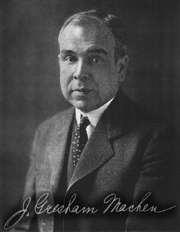
Fundamentalism has greatly--and I mean severely--affected Reformed thinking in America. The Bible--thanks to the fundamentalists--has been reduced to propositional statements about God and most American Christians read their Bibles in an ahistorical fashion. Scholars in this camp have no problem with the study of history per se, but to read the Bible as an historical document is seen as a "liberal" endeavor. But much of the reformed world in America would have no problem allying itself with the great founder of Twentieth-Century reformed thinking, J. Gresham Machen. But what does Machen himself believe?
The student of the New Testament should be primarily an historian. The centre and core of the Bible is history. Everything else that the Bible contains is fitted into an historical framework and leads to an historical climax.
...
Give up history, and you can retain some things. You can retain a belief in God. But philosophical theism has never been a powerful force in the world. You can retain a lofty ethical ideal. But be perfectly clear about one point--you can never retain a gospel. For gospel means 'good news', tidings, information about something that has happened. A gospel independent of history is simply a contradiction in terms.
Could it be any clearer?
Saturday, January 21, 2006
Nick Perrin on Guy Waters in the New WTJ
For those of you who haven't heard, Nick Perrin (Asst. Prof. at Wheaton; formerly at Biblical; and formerly N.T. Wright's research assistant at Westminter Abbey) has just published a book review/critique of Guy Waters' "Justification and the New Perspective."
Perrin is more than fair as he points out Waters' unfairness. He points out that Waters' tone is less than Christian and inflammatory. Here's an excerpt:
First, it goes without saying that the book must be assessed not only for what it says, but for how it says what it says. On this score, even those who are sympathetic to Waters's conclusions would have to concede the book provides an unhelpful model as to how one engages in theological discussion. Inflammatory assertions like, '[I]ronically, it is the ignorance of historical theology on the part of Wright and other scholars that prompts them to make such affirmations...' is simply disrespectful and as such, sub-Christian (1 Peter 3:15-16).
This has always been a major critique of the Reformed critics of the NPP.
Friday, January 20, 2006

Ordination and Installation as Assistant Pastor of Redeemer Presbyterian Church
By God's grace--and it's nothing less--I passed my ordination exams this past Saturday and will be ordained and installed as assiatant pastor of Redeemer Presbyterian Church, NYC on January 22, 2005. As for my ordination exam, all I can say is that it was very fair! And as for my ordination and installation service, Rev. John Lin will be introducing me and reading me my vows; Rev. Scott Strickman will be giving me my charge; and the Rev. Dr. Tim Keller will be praying the ordination prayer itself.
Monday, September 27, 2004
For Those Who Appreciate Pomp and Symbolism
If Christian culture is to be renewed, habits are more vital than revivals, rituals more edifying than spiritual highs, the creed more penetrating than theological insight, and the celebration of saints' days more uplifting than the observance of Mother's Day. There is great wisdom in the maligned phrase ex opere operato, the effect is in the doing. Intention is like a reed blowing in the wind. It is the doing that counts, and if we do something for God, in the doing God does something for us.
The poet Dana Gioia, the current director of the National Endowment for the Arts, puts it nicely in the poem "Autumn Inaugural":
There will always be those who reject ceremony, who claim that resolution requires no fanfare, those who demand the spirit stay fixed like a desert saint, fed only on faith, to worship in no temple but the weather.
Gioia acknowledges the point:
Symbols betray us.They are always more or less than what is really meant.
Then:
But shall there be no processions by torchlight because we are weak? Praise to the rituals that celebrate change, old robes worn for new beginnings, solemn protocol where the mutable soul, surrounded by ancient experience, grows young in the imagination's white dress. Because it is not the rituals we honor but our trust in what they signify, these rites that honor us as witnesses--whether to watch lovers swear loyalty in a careless world or a newborn washed with water and oil.
If Christ is culture, let the sidewalks be lit with fire on Easter Eve, let traffic stop for a column of Christians waving palm branches on a spring morning, let streets be blocked off as the faithful gather for a Corpus Christi procession. Then will others know that there is another city in their midst, another commonwealth, one that has its face, like the faces of angels, turned toward the face of God.
Robert Louis Wilken, First Things, April 2004.
Saturday, July 24, 2004
The Contemporary Pulpit: Midrash at its Best!
Instead of all the commotion some are causing in reformed-evangelical circles about the use of Second Temple and Rabbinic Judaism sources and whether or not they are helpful to current Christian discussions, one might begin by thanking these Jewish exegetes and preachers for the helpful framework and tradjectories they provided us with. Can anyone truly admit that contemporary Christian preaching is anything other than midrash? Richard N. Longenecker says that midrash is
"...exegesis which, going more deeply than the more literal sense, attempts to penetrate into the spirit of the Scriptures, to examine the text from all sides, and thereby to derive interpretations which are not immediately obvious."
and
"Midrashic interpretation, in effect, ostensibly takes its point of departure from the biblical text itself (though psychologically it may be motivated by other factors) and seeks to explicate the hidden meanings contained by means of agreed on hermeneutical rules in order to contemporize the revelation of God for the people of God."
Sound familiar? We are post-modern midrashic preachers of Chirst!
Saturday, June 19, 2004
Epistemology: Van Til and Wright
This is my third reading of N.T. Wright's New Testament and the People of God. And with this pass I am struck--once again--by the similarities between Van Til and Wright. (1) Both authors argue that there is no such thing as a "brute fact" or "mere history," to use Wright's term; (2) both authors sternly critique the Enlightenment project and reveal its presuppositions and subsequent failures; (3) both authors argue for a way of doing theology and history that, at bottom, is circular (a very "post-modern" way of thinking); and (4) both authors recognize that all "knowing" involves circularity (there's just no ifs, ands, or buts about it!).
So what's all the commotion about? Oh, I get it: Wright is an Anglican and not a Presbyterian. And furthermore, he didn't teach at Westminster Theological Seminary. Therefore, he couldn't be saying anything we could embrace.
Thursday, April 15, 2004
N.T. Wright on the Radio in the UK
Listen to N.T. Wright defend the Easter message of the Resurrection of the Son of God on a radio interview from the UK.

Wednesday, April 14, 2004
Women and Silence: Is "Saul the Rabbi" Employing a Rabbinic Formula in 1 Corinthians 14:33-35?
For my ethics class at Westminster Theological Seminary, Philadelphia, I decided to engage the "women's issue" as my topic (but more specifically, "the women and silence" issue of 1 Cor 14). I thought it would be good for me--in my final semester--to wrestle with this issue, especially since it is one of the hot-button topics in post-Christian NYC. I chose to interact with Richard Hays on the matter: (1) because I agree with a handful of his outcomes; and (2) because I disagree (as of now) with his hermeneutical entry-gate into the issue. But to engage Hays means I must also engage Elizabeth Shussler Fiorenza, Victor Paul Furnish and others, since Hays follows their lead on a variety of issues.
1 Corinthians 14:33-34 reads:
For God is not a God of disorder but of peace. As in all the congregations of the saints, women should remain silent in the churches. They are not allowed to speak, but must be in submission, as the Law says. If they want to inquire about something, they should ask their own husbands at home; for it is disgraceful for a woman to speak in the church. (NIV)
Preliminary Considerations
(1) The first thing we must remember is that the punctuation is interpretive.
(2) With the punctuation in mind, the "As in all the congregations of the saints" of v. 33b should be read as continuing the thought of v. 33a, not beginning the thought of v. 34 (as the NIV renders/obscures it). By following the NIV, the thought of v. 33b is redundant, since the Greek for "congregations" and "churches" is the same word, ekklesia. "As in all the churches...in the churches."
(3) Hays uses Gal 3:28 as the hermeneutical lens into the 1 Corinthian passage. (Moreover, Hays believes that 1 Cor 14:33-36 is an interpolation. Fiorenza, on the other hand, says we must deal with it regardless if it is Pauline or deutero-Pauline.)
(4) Most commentators, including Hays, recognize that Gal 3:28 has rabbinic roots--it is part of the prayer that every good Jew of the first-century would say each day:
Rabbi Jehuda said, One must speak three prayers every day:
Blessed be God that he has not made me a Gentile.
Blessed be God that he has not made me a woman.
Blessed be God that he has not made me a boor. (T. Berakoth)
(5) If Paul is echoing a rabbinic formula in Gal 3:28, why not in 1 Cor 14:33-35?
(6) With point (5) and point (1) in mind, can we read 1 Cor 14:34b-35 as follows: "[Women] are not allowed to speak, but must be in submission, as the law says, "If [women] want to inquire about something, they should ask their husbands at home..."
(7) We do know that the women of the first-century were not entitled to speak in the ekklesia, both Jewish (the "assembly," in the LXX) and Greco-Roman (the "assembly" of the polis).
(8) Is Paul just carrying this understanding into the church?
(9) If so, what does that do to how we understand Paul's understanding of the "law?" Is Paul's understanding of the "law" wider than we have come to believe?
Of course, point (6) is not fully substantiated at this moment. But I am hopeful to find something in the rabbinic sources that makes some sense of it.
Again, these were just some of my initial thoughts.
Monday, March 22, 2004
Euangellio-telic?
What is the "center" of Paul's theology? Is it the doctrine of justification? Is it his doctrine of the Holy Spirit? Or, to ask a more profound question: Is there a center to Paul's thought or any other NT writer, for that matter?
In Reformed circles some years ago, we began to employ the term "Christocentric" to describe Paul's hermeneutic as well as the hermeneutics of other NT writers. At WTS, Philadelphia, Dr. Douglas Green borrowed a term from Richard Hays ("ecclesio-telic") and applied the "telic" sense of this term to the way the NT writers interpreted the OT. Green began to speak of "Christo-telic" hermeneutics--finding a passage's fulfillment in Christ, but still doing justice to what he called a "first reading." (This is especially true when exegeting OT passages.) This is a profound tweaking of the former "Christocentric" understanding. It basically says that our hermeneutic should have Christ as its telos. But does "Christo-telic" do justice to how the OT writers were thinking? Were they awaiting Jesus Christ? Probably not specifically! Let us consider this: Euangellio-telic or Gospel-telic. I believe it does justice to both the anticipated fulfillment of the OT writers as well as the realized fulfillment of the NT writers.
Saturday, February 07, 2004
Echoes of the Psalms in the Gospel of Mark
As I was preparing a Bible study for a homegroup that meets in Brooklyn, I was struck by Mark's use of, or reflection on, Psalm 23 in the sixth chapter of his Gospel. Mark is undeniably painting Jesus as the shepherd of that psalm, or we might even go as far to say that Mark is finding Psalm 23's fulfillment in the feeding of the five-thousand. For me the dead give away was Mark's mention that "Jesus directed them [the apostles] to have all the people sit down in groups on the green grass" (v. 39). After noticing this, I immediately turned to the LXX to see how it rendered the green grass of Psalm 23 in the MT. Both the LXX and Mark employ a derivative of cloros. But that's not where it ends. The obvious reflection is v. 34, "They were like sheep without a shepherd," which echoes v. 1 of Psalm 23. Furthermore, v. 42 of Mark 6 says that "they all ate and were satisfied," which echoes vv. 5a and 1 of Psalm 23, "You prepare a table before me" and "I shall not be in want." It was disappointing to find that the commentaries were silent on this one (not that my commentary library is exhaustive). But I was encouraged to see that Mark Horne's excellent book, The Victory According to Mark (which I just picked up this week), does, in fact, point this up.