Redeemer Presbyterian Church: Good Friday Meditation
The Sixth Word
Later, knowing that all was now completed, and so that the Scripture would be fulfilled, Jesus said, "I am thirsty." A jar of wine vinegar was there, so they soaked a sponge in it, put the sponge on a stalk of the hyssop plant, and lifted it to Jesus' lips. When he had received the drink, Jesus said, "It is finished." With that, he bowed his head and gave up his spirit.
If there’s one Greek word that English speakers need to understand in order to grasp the profundity of Good Friday, it’s the Greek word tetelestai, which means, “It is finished.” Because on a certain Friday afternoon, on that dark and bleak day, some 2000 years ago, one man, in the last moment of his life, would utter this one word--A word that would change the course of history; a word that word complete the task of God. And, again, that’s the word tetelestai, “It is finished.”
But when that word left the mouth of that one man, what did he mean? What, in fact, was finished?
Well, in order to understand this word, we have to put it in context. You see, like looking at a great painting from the renaissance, in order to understand the subject in the foreground, it’s important to understand the background, which gives the subject its context. So, what’s the background that will bring this word into sharp relief?
Well, the background is the opening chapters of Genesis. You see, John’s Gospel begins with the same words as does the Book of Genesis, “In the beginning.” So, with these words, John is trying to tell us something right off the bat. He’s trying to tell us that his Gospel is going to echo in some way--however slightly--the opening chapters of the Bible. And the opening chapters of the Bible tell us one thing: How God created the heavens and the earth.
You see, the opening chapters of Genesis are structured around the seven days of creation--day one: God creates light; day two: God creates the sky or the heavens; day three: He separates the water from the land; day four: He creates the sun and the moon and the stars; day five: He creates the beasts of the field, the birds of the air and the fish of the sea. And then on day six, before God rests on day seven, Genesis tells us that God created humanity in his own image and crowned them with glory and honor. Then the writer of Genesis tells us that when the creative process was completed, when God looked at his creative work, He said one thing, “It is very good.”
But notice what God didn’t say. He didn’t say, “It is finished.” And John gives us a hint as to why?
You see, not only does John open up his Gospel with the opening words of Genesis--“In the beginning”--but he structures his entire account around seven statements too: The seven “I am” statements of Jesus.
In chapter 6 of John’s Gospel Jesus says, “I am the bread;” in chapter 8 He says, “I am the light of the world;” in chapter 10 He says, “I am the door;” Also, in chapter 10 Jesus says, “I am the good shepherd;” then, in chapter 11 He says, “I am the resurrection and the life;” then, later in chapter 14 He says, “I am the way and the truth and the life;” and then finally, in chapter 15 Jesus says, “I am the true vine.”
You see, John is doing everything he can to echo the Book of Genesis with the hope that we latch onto one very important thing: Where Genesis tells the story of creation his Gospel tells the story of re-creation--it tells the story of redemption.
So, with Genesis as the backdrop, what does tetelestai mean? What does “It is finished” mean?
Well, it doesn’t mean that God…threw in the towel! It doesn’t mean that God gave up!
It doesn’t mean that God resigned!
You see, what is finished is our vain attempts of redeeming ourselves.
You see, on that certain Friday afternoon, on that dark and bleak day, one man, would utter one word, and that word would set us all free--free from the bondage of trying to redeem ourselves.
Monday, March 24, 2008

Monday, March 26, 2007
PROLEGOMENA: Redeemer Presbyterian Church
Sunday, March 26, 2007
Good Friday, the day that Christians celebrate, or we might even say, mourn the death of Jesus Christ, well that day is fast approaching. And like most churches around the world, Redeemer will have a Good Friday service. And not just one service, but four: Two on the Eastside and two on the Westside. Now, many of us will come to those services; and we’ll come to those services straight from work, dressed in our business suits, sporting Brooks Brothers, Prada, and your Gucci attire. Yet strangely enough, all of us, because of what we’re wearing, will be, in some sense, out of sync with the reality of Good Friday when we walk in the door. Because the essence of Good Friday is about something quite the opposite of the way we’ll look as we enter those services. You see, in John 19 we overhear this conversation about the reality of Good Friday:
"When the soldiers crucified Jesus, they took his clothes, dividing them into four shares, one for each of them, with the undergarment remaining. This garment was seamless, woven in one piece from top to bottom. 'Let's not tear it,' they said to one another. 'Let's decide by lot who will get it.' This happened that the scripture might be fulfilled which said, 'They divided my garments among them and cast lots for my clothing.' So this is what the soldiers did."
You see, the God we come to worship this morning; the God we come to sing praises to, was stripped naked! Was completely exposed! Was laid bare! in order to cloth us with something far beyond Brooks Brothers and Prada. He was striped naked to clothe us in His righteousness itself! So, are you ready to worship this God this morning? Welcome to worship!

Monday, March 12, 2007
Redeemer Presbyterian Church
PROLEGOMENA: Sunday, March 11, 2007
As some of you may already know, today is the third Sunday of Lent, which, by the way, is 40 day period that Christians prepare themselves to celebrate the death and resurrection of Jesus Christ. Now, many churches around the world this morning will be reading from Psalm 63--the liturgical reading of the day. So, I thought I’d take the liberty to join Redeemer’s voice in with the voice of the global church. Verse 3 of Psalm 63 reads: “Because your love is better than life, my lips will praise you.”
Now, I don’t think David was completely aware of the hint we got from him when he penned this psalm, because to talk about God’s love is to always have Good Friday in view--the day that Jesus died. And it's John who helps makes sense of this for us when he says, “This is how we know what love is: Jesus Christ laid down his life for us.” You see, according to John’s statement, to understand what love is, is to bring Good Friday into sharp focus in your mind’s eye. So, are you ready to praise God this morning because of the picture of love we get when we focus in on the three dark hours of that one Friday two, or so, millenia ago? Welcome to worship!

Thursday, February 09, 2006
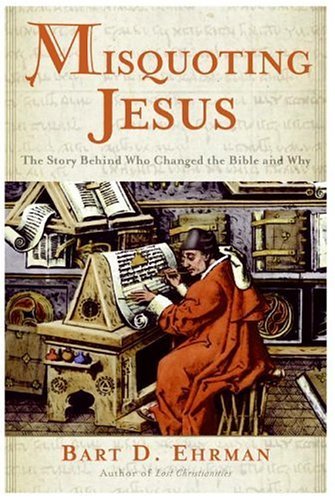
Yes Bart, We Know! (And Have Always Known!)
Bart Ehrman, a NT scholar from North Carolina University, Chapel Hill, has recently published a new book entitled, Misquoting Jesus: The Story Behind Who Changed the Bible and Why. The book--for the most part--is a conglomeration of all the well-known textual critical issues in the NT. The question the book leaves me with at this point in my reading (about half-way through) is: Why did Ehrman write this book?
It seems Ehrman is making another attempt to rattle the evangelical world--to remind evangelicals that the Bible that they read is riddled with "problems." It would be difficult in this brief review to interact with the many textual and transmissional issues that Ehrman touches on. What I can do, however, is (briefly) interact with two thoughts from the back cover.
In Misquoting Jesus Ehrman reveals that:
- The King James Bible was based on corrupted and inferior manuscripts that in many cases do not accurately represent the meaning of the original text.
- The favorite Bible story of Jesus's forgiving the woman caught in adultery (John 8:3-11) doesn't belong in the Bible.
Guess what Bart...we know! We know the KJV and the Textus Receptus are "inferior." We know that John 8:3-11 may be a later gloss and that it's not included in the earliest of manuscripts! My questions is: So what?! Is the way of salvation offered in the gospel obscured by any of this? Not in the least!
My parting comment to Ehrman is for him to read Inspiration and Incarnation: Evangelicals and the Problem of the Old Testament by Peter Enns.