A Question Asked to Ann Landers About "Group Blogging"
Dear Ann,
I am at the end of my rope and in desperate need of your advice! As a member of a group blogging effort, I find myself struggling with the fact that one of my blogging colleagues is always writing silly, outlandish and narcissistic posts. His blog posts (which for the most part are pseudonymous) are an embarrassment to our otherwise fine group of bloggers. But what makes this all the more difficult for me is this: he cloaks it all in "humor." Please help me/us before the entire blogging community writes me/us off.
Signed,
A Concerned Group Blogger
Showing posts with label Culture. Show all posts
Showing posts with label Culture. Show all posts
Sunday, February 17, 2008

Friday, February 15, 2008
Clerical Collars + Soul Patches = A "True Man" and a Cool Pastor
First, for hundreds of years, if not a millennium or more, clergy have been sporting clerical garb. This is not limited to Roman Catholics, Anglicans or Lutherans. What's more (and what's interesting) is that Puritans (the ones we'd all think would not sport such garb) also thought it a good idea to do so. Here, see for yourself:
If a clerical collar was good enough for this Puritan, I'm sure it's good enough for anyone else. Moreover, I could have posted the likeness of Thomas Boston, Thomas Brooks, etc. to make my point.
Second, if there's one style of facial hair that screams "COOL" it's the soul patch. And who's cooler than Johnny Depp? 
Therefore, the math is simple:
A CLERICAL COLLAR + A SOUL PATCH = A "TRUE MAN" AND A COOL PASTOR
P.S. Methinks he doth protest too much. Perhaps he's just jealous?
Sunday, August 26, 2007
Keeping the Tenth Commandment by "Walking" in the Spirit
Last night I preached a sermon at Redeemer Presbyterian Church of New York City on the Tenth Commandment closing out our summer series on the Ten Commandments. If you'd like to, you can purchase it here.
What follows is an abbreviated intro and the outline:
Intro
We may think that the Tenth Commandment is the least important of the Ten and/or it may be the one we least understand. We may think it's the least important because it's the last in the list of the Ten. So we think to ourselves, if it's the last in the list, then it must me the least important. But the Tenth Commandment may be the second most important simply because it is the tenth; simply because it one of the bookends of the Ten.
But also, it may be the one we least understand because we've become completely desensitized to its meaning. Think of all the synonyms for the word covet: desire, envy, crave, yearn. Every one of these words has a perfume named after it. So we have Desire by Dunhill; Envy by Gucci; Crave by Calvin Klein; and, Yearn by Victoria's Secret. Therefore, our culture has done a good job of desensitizing us to its meaning.
So, let's figure out what this commandment means by looking at it under three headings. Let's look at:
1. What It Is (let's define it)
2. What It Leads To
3. How It Can Be Kept
Monday, August 13, 2007
PROLEGOMENA: Redeemer Presbyterian Church
Sunday, August 12, 2007
This past Tuesday, in the Op-Ed Section of the New York Times, David Brooks had a column that spoke about the significance of names entitled, “Goodbye, George and John.” Now, while the article was a little tongue-in-cheek, Brooks tried to point out the fact that a person’s name can really matter and define who they are. And in the humor of David Brooks, he says that’s why he named his two children President and Hedge Fund Manager, respectively. But despite the humor, I think Brooks is onto something. Yet, I don’t think Brooks is on to anything new.
You see, in the opening chapter of Matthew’s Gospel, we read this, “Mary will give birth to a son and you are to give him the name Jesus, because he will save his people from their sins.”
You see, the God we come to worship this morning; the God we come to sing praises to, has always understood the significance of a name. And the Apostle Paul makes that clear in his letter to the Philippians when he says, “That now, at the name of Jesus, every knee will bow in heaven and on earth and under the earth and every tongue confess that Jesus Christ is Lord to the glory of God the Father.
So, are you ready to worship the One this morning whose name stands above every other name? Welcome to worship!
Monday, August 06, 2007
PROLEGOMENA: Redeemer Presbyterian Church
Sunday, August 5, 2007
This past Thursday, on the front page of Metro Section of the New York Times, there was an article entitled: "When a Mayor Plays Just Another Straphanger.” And the article spoke about one way that NYC mayors have attempted to rub elbows with their constituency over the years and paint themselves as “regular guys.” And the way that most mayors have chosen to do this (according to the article) is by using the subway system from time to time--because to ride the subway is to do something that every New York does. It’s a way of condescending; a way of stepping into the shoes of the average New Yorker. In other words, it’s a way of becoming…one of us.
And that’s something like what the God we come to worship this morning has done.
You see, the God we come to worship this morning; the God we come to sing praises to, has lived in your shoes, has felt what you have felt, and has experienced all the ups-and-downs of this life the moment he became…one of us.
So, are you ready to worship the God who has become one of us this morning? Welcome to worship!
Monday, July 16, 2007
PROLEGOMENA: Redeemer Presbyterian Church
Sunday, July 15, 2007
Thirty years ago this week, on July 13, 1977, New Yorkers were able to equate two concepts that the ancients have equated for thousands of years. We were able to equate darkness with chaos. You see, on that hot and sticky night in July, the city experienced a blackout. And as a result of the darkness, there was mayhem. Neighborhood stores were looted; much of the city was vandalized; and, block after block of the city was set ablaze. Furthermore, this chaos continued until the power was restored late the next day when all the lights of the city went back on.
Now, the opening chapter of the Bible tells us something similar. It reads, “In the beginning God created the heavens and the earth. And the earth was chaotic and void while darkness covered the face of the deep… And then God said ‘let there be light.”’
Do you see what I’m getting at?
The God we come to worship this morning; the God we come to sing praises to, has ordered the chaos when his light broke through the darkness of the world. And that light (we’re told by the Apostle John) is none other than Jesus Christ himself.
So, are you ready to worship the light of the world, Jesus Christ our Lord? Welcome to worship.
Monday, June 25, 2007
PROLEGOMENA: Redeemer Presbyterian Church
Sunday, June 24, 2007
A few weeks ago, in the Sunday Styles section of the New York Times, there was an article that described how one man single-handedly changed the Lower East Side.
Now the Lower East Side when I was a kid was a neighborhood in steep decline. And the only reason you’d find yourself down there was to get a pastrami on rye from Katz’s Deli on Houston Street (pronounced House-ton; not pronounced like the city in Texas).
But Sion Mishrahi has found a way to breathe new life into that community. He has single-handedly restored the things that were once broken; he has brought beauty to a place where beauty was once hard to find; and he has given new hope to a community that once felt abandoned by the powers that be in the city. Sound familiar?
It should! Because this story is merely a faint echo of the story that the Bible tells us.
You see, the God we come to worship this morning; the God we come to sing praises to has also brought restoration and new life to a community--except this community is not defined by geography, but by those who believe in the death and resurrection of the Son of God.
So, are you ready to worship Jesus Christ, the Son of God, who is the renewer and restorer of all things? Welcome to worship!
Monday, June 11, 2007
No Pepper in the Salt of the PCA!
As I plan to leave for another General Assembly of the PCA, I am reminded of the horror I experienced last year when I walked into the convention hall for the first time. Out of the 1800 or so commissioners on the floor of GA, you could literally count the number of African-American ministers in the denomination.
Now that Redeemer has one of the thirty-three Blacks in the denomination (Rev. Mark Robinson), I have found myself growing more sensitive to this issue. I am looking forward to seeing old friends; I am looking forward to debating the FV/NPP issue; I am NOT, however, looking forward to seeing the lack of diversity in this denomination once again! Therefore, it is my opinion that the PCA has to make a concerted effort to recruit Black ministers in the denomination and get FAR beyond the number 33! Or to put it bluntly: 33 African-American ministers out of roughly 2000 is something we should all be ashamed of! Talk about inequity!
Thursday, May 31, 2007
Sabbath = Good Eats: Borinquen Style!
The one good thing about having Puerto Rican cousins, aunts and uncles is that you can visit Puerto Rico and practically stay for free. Moreover, all the hole-in-the-wall food joints that are on their maps wind up on your map as well. Therefore, all you have to do is tag along to taste the entire island.
We went to a wedding in El Yunque, that's the rain-forest; then to a reception at a cousin's cousin's house in Carolina and had amazing paella. Next, we spent Tuesday night in Ponce (which is a 2 hour drive through the mountains from San Juan) and woke up to great cafe con leche and wonderful breads. Then, on the drive back from Ponce, we stopped at this little roadside joint (and I mean joint) in Caguas where we had succulent pig (lechon) and great arroz habichuelas (that's rice and beans), yuca (that's a starchy root vegetable like a potato) and different PR sausages.
Right down the street from the place we were staying on the last two nights (in order to escape my crazy family) was a wonderful little sandwich place that had great cafe, an array of Cubano sandwiches and fresh squeezed china (that's PR for orange juice). (Orange juice got the name "china" in the early part of the twentieth century when the crates used to pack the oranges bound for the USA were branded: MADE IN CHINA.)
Enough about food: I think the single most exciting moment for me was going with my PR cousins and uncles to the cock fights (and losing $60). What a bizarre experience!
[The photo above is of my daughter Hannah and me.]
Monday, May 21, 2007
PROLEGOMENA: Redeemer Presbyterian Church
Sunday, May 20, 2007
A few weeks ago, in the magazine section of the New York Times, there was an article entitled: “Reinventing Middle Age.” Now, the article attempted to show how Americans, especially New Yorkers, fear the inevitable--we fear growing old. And if we fear growing old, then it logically follows that we fear death.
Now, the writer drove this point home to me when she said this: “For one thing reality has hit me in the eyebrows where I first started going gray some years ago and where I keep going grayer underneath renewed coatings of eyebrow tint.”
You see, what the writer made clear to me was this: We’ll do anything to avoid the inevitable; we’ll do anything to avoid the downward spiral of this life. We're all guilty of this at some level--every one of us.
Yet, we’ll disagree with that when we sing the first line of the opening hymn which reads, “A mighty fortress is our God a bulwark never failing. Our helper he amid the flood of mortal ills, prevailing!”
You see, the God we come to worship this morning; the God we come to sing praises to, has given us hope beyond our graying hair. And that happened the moment Jesus stepped out of the tomb. So, are you ready to worship the God who gives us hope beyond death this morning? Welcome to worship!
Wednesday, April 25, 2007
A War of Narratives: What the PCA Can Learn from NY Times Columnist David Brooks
David Brooks, an Op-Ed writer for the New York Times, has put his finger on what I believe is the problem with most disagreements today, especially those within the PCA. While at a conference that brought together Americans and moderate Arab reformers, Brooks recognized that the two groups just "passed each other without touching." That is to say, one group was talking about X, while the other group was talking about Y, and "never the twain met or shall meet." Why? Brooks noticed that each side "had a different narrative." That is, they told themselves different stories to make sense of the data.
Now, narratives make sense of reality for human-beings. We use them all the time to make sense of the data that life throws at us, especially the data that we don't quite have categories for. Thus, we tell ourselves stories in order to fit the data into categories so we can understand the world.
Within the current debates in the PCA on the New Perspective on Paul (NPP) and the Federal Vision (FV), each side of the debate has its own narrative to make sense of the data; and if each side has its own narrative, then it also has different vocabulary; and if different vocabulary, then, never the twain shall meet!
Therefore, if we (in the PCA) first recognize that we're talking beyond each other and that each group makes sense of what's going on by telling itself a different story, then we might (and I say, "might") make it beyond the (narratival) impasse.
Saturday, March 24, 2007
Sao Paolo, Brazil: The Next Constantinople?
The epicenter of the church has always been in the world's largest cities, ever since the time of Paul. So, just imagine the City of New York, with three times the population, approximately twice the square mileage (NYC: 321; SP: 588), with high-rise buildings as far as the eye can see, only with far less the architectural beauty of Manhattan. That's Sao Paolo, Brazil.
In my previous post, I mentioned that the center of the world Christian movement has and will continue to shift into the global south and east--into cites like Sao Paolo, Mexico City, Shanghai, and Dhaka. As a result of this shift, I challenged us to consider the possibility that the Western church (North America, Europe and England) will need to give up its paternalistic dominance with regard to the future of how the Christian faith is and will be articulated.
Lamin Sanneh at Yale Divinity School in his book Whose Religion is Christianity: The Gospel Beyond the West agrees with this when he writes, "Christianity should not anywhere be about the refusal to change the old; it should be about the willingness to embrace the new."
When the center of the church shifted to Rome from Constantinople and Antioch in the first millennium, the church did not do away with what was previously established. It did, however, continue to address issues in light of the church's new context given the new questions it was asking. All one has to do to confirm this is take a close look at the seven ecumenical councils to see that each council affirmed what was theretofore created and accepted by the preceding councils. For example, the Council of Chalcedon affirmed and built upon the Council of Nicea.
Therefore, the church is faced with a similar situation today. Will it seek to undermine what was established in centuries past? Will it be afraid of the voice from the South and East that is now a whisper but can soon be a scream? If the church was able to weather the storm of the first shift from the South and East to the West, it should, by God's grace, be able to weather the storm back. Thus, places like Sao Paolo will soon be the "Constantinopes" of the Christian World once again.

Thursday, March 01, 2007
The Hermeneutics of Life
Every day we try to make sense of life. And if not just our own lives, then we (especially pastors) try to help others make sense of theirs. It's simply one of the great human (and pastoral) endeavors! It doesn't matter what it is we're dealing with, or what we're trying to sift through, because the fact remains, we're always "dealing" and "sifting." Why? Because we never have all the data! It's just impossible! In other words, we're forced to attempt to make sense of our lives (or the lives of others) with various little bits and pieces of the story. New information is always surfacing; new data is always coming to the fore. Sometimes I think it's a kin to painting by numbers or a jigsaw puzzle--that all we can do is take an educated guess at what the picture is as we put color on the canvas or put another piece in the puzzle.
In Grant R. Osborne's book, The Hermeneutical Spiral, "Osborne contends that hermeneutics is a spiral from text to context--a movement between the horizon of the text and the horizon of the reader that spirals nearer and nearer toward the intended meaning of the text and its significance for today."
Making sense of life's situations is much the same as Osborne's thesis (especially in pastoral counseling). We move between the bits of data we receive and how we understand them, spiraling ever closer to "the truth"--what's really going on; what someone truly needs.
The "hermeneutics of life" can also be compared to viewing a Lichtenstein  painting (since a Lichenstein is nothing other than a collection of dots: To view it properly you'll have to move between getting very close to the canvas and backing off it. If you're too close to the canvas, all you'll notice are large dots that make absolutely no sense; if your too far off, you'll never notice that the painting is a collection of dots. The movement between to two is essential!

Tuesday, April 04, 2006

Philippians 1:15-18 and The New York Times Best Sellers
Out of the 71 books listed on the New York Times' Best Sellers lists this past Sunday, 7 of them (nearly 10%) are dealing with Jesus in some way.
Hardcover Fiction: #1 The Di Vinci Code; Hardcover Non-Fiction: #5 Misquoting Jesus; Hardcover Non-Fiction: #12 What Jesus Meant; Paperback Fiction: #14 Angels and Demons; Paperback Non-Fiction: #13 Holy Blood, Holy Grail; Paperback Non-Fiction: #15 The End of Faith; Hardcover "How -To:" #2 The Purpose-Driven Life.
In Philippians 1:15-18 Paul says,
It is true that some preach Christ out of envy and rivalry, but others out of goodwill. The latter do so in love...The former preach Christ out of selfish ambition...But what does it matter? The important thing is that in every way, whether from false motives or true, Christ is preached. And because of this I rejoice.
The question is: Would Paul rejoice after seeing the New York Times Best Seller lists? I believe that he would knowing that the resurrected Lord of the cosmos was being considered by people in some form or another!
Tuesday, March 14, 2006
Huckster Finnster the Hipster
If Mark Twain had been born a century later in Williamburg, Brooklyn, then the title of his great work most likely would have been "Huckster Finnster the Hipster." Huckster's haberdasher would have insisted that he sport a trucker cap (slightly off center), a 1970's pin-stripe suit jacket (a bit too small), along with Levis (with grease stains), while kicking around with Pro Cons (Chuck Taylor's) as his rides. These clothing items would have replaced his straw weave hat, the suit that the widow Douglas purchased for him and his bare feet.

Thursday, March 02, 2006

Redeemer Times NYC Equals Orthodoxy?
After months and months of phone calls, Michael Luo--the new religion-beat writer for the New York Times--finally hunted down Tim Keller of Redeemer Presbyterian Church and convinced him to cooperate for a front page article in the Sunday Times Metro Section. Most of you might be asking: Why would Keller (or any pastor) disapproave of such exposure? The truth is, Redeemer shies away from the media since it is a church of 4500 and growing.
What might be more interesting than the article itself (an article which I personally found to be a bit flat), is that Luo, an "evangelical" himself, has communicated to the Times that they need to take religion in general and "evangelicals" in particular more seriously. The Times for many years has associated evangelicals with mainstream American fundamentalism, and as a result, mocked this group of readers. But if you can recall, one of the subtexts of the article was to clearly point out Redeemer's discomfort with the term "evangelical" due to all the cultural baggage attached to it, and instead opt for the term "orthodoxy." Personally, I'm more comfortable with the term "orthodoxy" too, since it connects the church at large and Redeemer in particular to the historic Christian church of all times and all places.
Thursday, February 09, 2006
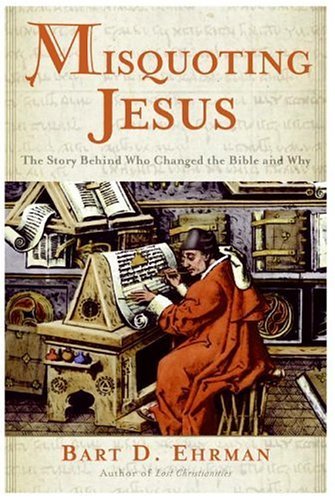
Yes Bart, We Know! (And Have Always Known!)
Bart Ehrman, a NT scholar from North Carolina University, Chapel Hill, has recently published a new book entitled, Misquoting Jesus: The Story Behind Who Changed the Bible and Why. The book--for the most part--is a conglomeration of all the well-known textual critical issues in the NT. The question the book leaves me with at this point in my reading (about half-way through) is: Why did Ehrman write this book?
It seems Ehrman is making another attempt to rattle the evangelical world--to remind evangelicals that the Bible that they read is riddled with "problems." It would be difficult in this brief review to interact with the many textual and transmissional issues that Ehrman touches on. What I can do, however, is (briefly) interact with two thoughts from the back cover.
In Misquoting Jesus Ehrman reveals that:
- The King James Bible was based on corrupted and inferior manuscripts that in many cases do not accurately represent the meaning of the original text.
- The favorite Bible story of Jesus's forgiving the woman caught in adultery (John 8:3-11) doesn't belong in the Bible.
Guess what Bart...we know! We know the KJV and the Textus Receptus are "inferior." We know that John 8:3-11 may be a later gloss and that it's not included in the earliest of manuscripts! My questions is: So what?! Is the way of salvation offered in the gospel obscured by any of this? Not in the least!
My parting comment to Ehrman is for him to read Inspiration and Incarnation: Evangelicals and the Problem of the Old Testament by Peter Enns.
Tuesday, April 27, 2004
Nicholas D. Kristof of the New York Times a Van Tilian?
Nicholas Kristof is an Op-Ed writer for the NY Times. He won the Pulitzer Prize for his work during the Tianaman Square riots which was the research that produced his excellent book China Wakes. For many years I've been unsure of his position regarding evangelicals in New York and America since he likes to "straddle the line." In other words, he paints an ambiguous portrait. But his latest column, Hug an Evangelical, demonstrates, at the very least, that he thinks like a good Van Tilian! Now don't get me wrong, I'm not trying to suggest that Kristof is a Christian, or something. I'm simply intrigued with his consistent reasoning. Kristof argues in the piece that the gay coalition is not fully in line with their own presuppositions which are central to their agenda. They demand "tolerance," but that's just what they lack...tolerance for the evangelical community. In other words, they are what they hate!
Good work Nick Van Til!
Wednesday, April 14, 2004
Women and Silence: Is "Saul the Rabbi" Employing a Rabbinic Formula in 1 Corinthians 14:33-35?
For my ethics class at Westminster Theological Seminary, Philadelphia, I decided to engage the "women's issue" as my topic (but more specifically, "the women and silence" issue of 1 Cor 14). I thought it would be good for me--in my final semester--to wrestle with this issue, especially since it is one of the hot-button topics in post-Christian NYC. I chose to interact with Richard Hays on the matter: (1) because I agree with a handful of his outcomes; and (2) because I disagree (as of now) with his hermeneutical entry-gate into the issue. But to engage Hays means I must also engage Elizabeth Shussler Fiorenza, Victor Paul Furnish and others, since Hays follows their lead on a variety of issues.
1 Corinthians 14:33-34 reads:
For God is not a God of disorder but of peace. As in all the congregations of the saints, women should remain silent in the churches. They are not allowed to speak, but must be in submission, as the Law says. If they want to inquire about something, they should ask their own husbands at home; for it is disgraceful for a woman to speak in the church. (NIV)
Preliminary Considerations
(1) The first thing we must remember is that the punctuation is interpretive.
(2) With the punctuation in mind, the "As in all the congregations of the saints" of v. 33b should be read as continuing the thought of v. 33a, not beginning the thought of v. 34 (as the NIV renders/obscures it). By following the NIV, the thought of v. 33b is redundant, since the Greek for "congregations" and "churches" is the same word, ekklesia. "As in all the churches...in the churches."
(3) Hays uses Gal 3:28 as the hermeneutical lens into the 1 Corinthian passage. (Moreover, Hays believes that 1 Cor 14:33-36 is an interpolation. Fiorenza, on the other hand, says we must deal with it regardless if it is Pauline or deutero-Pauline.)
(4) Most commentators, including Hays, recognize that Gal 3:28 has rabbinic roots--it is part of the prayer that every good Jew of the first-century would say each day:
Rabbi Jehuda said, One must speak three prayers every day:
Blessed be God that he has not made me a Gentile.
Blessed be God that he has not made me a woman.
Blessed be God that he has not made me a boor. (T. Berakoth)
(5) If Paul is echoing a rabbinic formula in Gal 3:28, why not in 1 Cor 14:33-35?
(6) With point (5) and point (1) in mind, can we read 1 Cor 14:34b-35 as follows: "[Women] are not allowed to speak, but must be in submission, as the law says, "If [women] want to inquire about something, they should ask their husbands at home..."
(7) We do know that the women of the first-century were not entitled to speak in the ekklesia, both Jewish (the "assembly," in the LXX) and Greco-Roman (the "assembly" of the polis).
(8) Is Paul just carrying this understanding into the church?
(9) If so, what does that do to how we understand Paul's understanding of the "law?" Is Paul's understanding of the "law" wider than we have come to believe?
Of course, point (6) is not fully substantiated at this moment. But I am hopeful to find something in the rabbinic sources that makes some sense of it.
Again, these were just some of my initial thoughts.
Friday, January 30, 2004
What Can We Learn from the Quote of the Day?
"The reason we're doing this is to make God a part of the relationship. We are making our union with God in public. We do see it as a sacrament" (Jeffery A. Manley, who will exchange vows with his male partner in a church in March). Read the article.
What has happened to the New York Times Quote of the Day. I'm sure in years past, profound statements by politicians, statesmen and others of notoriety were published, intended for the readers growth. But now it has become a slot of the paper/rag to promote the "way-liberal" agenda! Yes, most NYers--including myself-- are "liberal," or, at least, registered democrats. But that shouldn't suggest that all NYers affirm the "extreme-left's" every agenda. We can, however, affirm the policies of the liberal-left that are in line with the truth of the gospel (e.g., social justice and all that it stands for and accomplishes)! But same-sex union is out of the question. My question today to the New York Times is: How is this quote helpful to the masses? It's far from a quote from Jesus Christ our Lord, Abraham Lincoln, Walt Whitman or Bugs Bunny (for that matter).
Subscribe to:
Posts (Atom)