Save Westminster Theological Seminary from Itself!
Click here to go to the most important link you can ever click.
Showing posts with label WTS. Show all posts
Showing posts with label WTS. Show all posts
Saturday, January 19, 2008

Thursday, July 19, 2007
The Book the PCA Study Committee Needed to Read:
The Saving Righteousness of God by Michael Bird
Michael Bird has done a wonderful and fair job sifting through the data on the New Perspective on Paul. Moreover (and for some strange reason) he has an interest in the debates inside the PCA (why? I don't quite know!). So, if you want a solid treatment of the issues pertaining to the debate within the PCA, PLEASE READ THIS BOOK!
At this point I'm only about halfway through the book, so to review it would be unfair. But I will say that it is the single best treatment of all the issues that I have read to date. Bird reminds us and demonstrates that Richard B. Gaffin (my former professor) has been more aligned with the NPP than he cares to admit! He also does a fine job of dealing with, dikaiosune theou; pistis Christou; and the biblical texts surrounding these issues and others related to justification by faith. Lastly, he grounds his work historically when necessary.
A MUST READ!
Friday, March 30, 2007
Semper Reformanda: Always Reforming!
Contra Carl Trueman on Reformation 21
My former church history professor, Carl Trueman of Westminster Theological Seminary in Philadelphia, recently posted a cautionary note to the church on Reformation 21 about whether or not, when and if, and by whom and why the church's creeds and confessions should be revised.
Allow me to counter Professor Trueman with these three points:
1. The later confessions of the church are undeniably Euro-centric. This includes, but is not limited to, the Westminster Standards, the Heidelberg Catechism, and Belgic Confession. Again, staying within the trajectory of my last posts, if the church desires a true ecumenism, that is, one that allows for the voice of all Christians everywhere to chime in (especially those of the non-Western church) we'll have to allow for confessional-reconstruction. In other words, the church will have to allow for non-Western, non-Enlightenment affected theology to creep into (and even dominate) its confessions.
2. Professor Trueman cautions us that "the church is more highly fragmented now." To this I say, "So what!" I must remind Professor Trueman that the "fragmentation" he speaks about is the product of the Protestant Reformation, the same people who felt that they had the right and/or obligation to revise and reconstruct the church's creeds. Moreover, this "fragmentation" is just the logical outworking of Luther et al's break with Rome. So, let's just deal with it instead of allowing it to handcuff us.
3. There is little doubt in my mind that some of the doctrines of the later confessions were affected by modernistic categories. For example, the modern banking system as we know it was conceived of and implemented by the Medici family in the 15th century. That's the same era that Luther speaks of justification in terms of accounting. [Hmmmm, interesting.] Maybe our non-Western sisters and brothers will help to see that our confessions recapture a filial aspect of redemption instead of all the modernistic legalese that hijacked it.
Therefore, if the church is "Semper Reformada," then it needs to always be reforming--even its creeds and confessions!
Monday, February 19, 2007

Happy President's Day!
I thought I'd celebrate "President's Day" this year by highlighting the current work of one president that I consider a friend, Dr. Samuel T. Logan. Sam is the former president and chancellor of Westminster Theological Seminary in Philadelphia, where he also taught church history for more than 25 years. He now serves as president of the World Reformed Fellowship (WRF), a free association of evangelical and Reformed churches from around the world. "WRF was formed to encourage understanding and cooperation among evangelical Presbyterian and Reformed denominations and institutions, and to link those institutions having ministry resources with those possessing vision but few resources. The fellowship promotes Reformed thinking, a Reformed world and life view, fosters evangelism and strategies on missions, church planting and theological education, and promotes international communication for the further advancement of the Gospel." WRF hopes
-to promote Reformed thinking and a Reformed world and life view;
-to inform and encourage churches and people who embrace the Reformed faith;
-to provide a forum for dialogue on current issues;
-to be able to offer direction to the evangelical Reformed community;
-to promote evangelization in the Reformed tradition;
-to maintain, strengthen, and defend the sound doctrines and
Biblical-theological tenets that distinguish us as Reformed Christians.
I became a member of WRF a few months ago for one simple reason: To get out of the American-Reformed plastic bubble and associate myself with Christians from around the world who are unlike myself (although, most everyone--according to Doug Green--are "unlike myself"). If, as Reformed Christians, we feel that we have something to offer the broader Christian world, then we should make it available. And that's what WRF is doing--sharing resources with and listening to the wider World-Christian voice, a voice that is becoming exceedingly louder with the expansion of the church in Africa and South America.
Sam, thank you for all your kingdom-work! Oh, and happy President's Day! (And, see you in San Paolo, Brazil in March!)
Friday, January 27, 2006
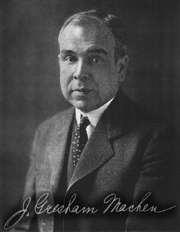
Parting with Tradition
Fundamentalism has greatly--and I mean severely--affected Reformed thinking in America. The Bible--thanks to the fundamentalists--has been reduced to propositional statements about God and most American Christians read their Bibles in an ahistorical fashion. Scholars in this camp have no problem with the study of history per se, but to read the Bible as an historical document is seen as a "liberal" endeavor. But much of the reformed world in America would have no problem allying itself with the great founder of Twentieth-Century reformed thinking, J. Gresham Machen. But what does Machen himself believe?
The student of the New Testament should be primarily an historian. The centre and core of the Bible is history. Everything else that the Bible contains is fitted into an historical framework and leads to an historical climax.
...
Give up history, and you can retain some things. You can retain a belief in God. But philosophical theism has never been a powerful force in the world. You can retain a lofty ethical ideal. But be perfectly clear about one point--you can never retain a gospel. For gospel means 'good news', tidings, information about something that has happened. A gospel independent of history is simply a contradiction in terms.
Could it be any clearer?
Saturday, January 21, 2006
Nick Perrin on Guy Waters in the New WTJ
For those of you who haven't heard, Nick Perrin (Asst. Prof. at Wheaton; formerly at Biblical; and formerly N.T. Wright's research assistant at Westminter Abbey) has just published a book review/critique of Guy Waters' "Justification and the New Perspective."
Perrin is more than fair as he points out Waters' unfairness. He points out that Waters' tone is less than Christian and inflammatory. Here's an excerpt:
First, it goes without saying that the book must be assessed not only for what it says, but for how it says what it says. On this score, even those who are sympathetic to Waters's conclusions would have to concede the book provides an unhelpful model as to how one engages in theological discussion. Inflammatory assertions like, '[I]ronically, it is the ignorance of historical theology on the part of Wright and other scholars that prompts them to make such affirmations...' is simply disrespectful and as such, sub-Christian (1 Peter 3:15-16).
This has always been a major critique of the Reformed critics of the NPP.
Saturday, June 19, 2004
Epistemology: Van Til and Wright
This is my third reading of N.T. Wright's New Testament and the People of God. And with this pass I am struck--once again--by the similarities between Van Til and Wright. (1) Both authors argue that there is no such thing as a "brute fact" or "mere history," to use Wright's term; (2) both authors sternly critique the Enlightenment project and reveal its presuppositions and subsequent failures; (3) both authors argue for a way of doing theology and history that, at bottom, is circular (a very "post-modern" way of thinking); and (4) both authors recognize that all "knowing" involves circularity (there's just no ifs, ands, or buts about it!).
So what's all the commotion about? Oh, I get it: Wright is an Anglican and not a Presbyterian. And furthermore, he didn't teach at Westminster Theological Seminary. Therefore, he couldn't be saying anything we could embrace.
Tuesday, April 27, 2004
Nicholas D. Kristof of the New York Times a Van Tilian?
Nicholas Kristof is an Op-Ed writer for the NY Times. He won the Pulitzer Prize for his work during the Tianaman Square riots which was the research that produced his excellent book China Wakes. For many years I've been unsure of his position regarding evangelicals in New York and America since he likes to "straddle the line." In other words, he paints an ambiguous portrait. But his latest column, Hug an Evangelical, demonstrates, at the very least, that he thinks like a good Van Tilian! Now don't get me wrong, I'm not trying to suggest that Kristof is a Christian, or something. I'm simply intrigued with his consistent reasoning. Kristof argues in the piece that the gay coalition is not fully in line with their own presuppositions which are central to their agenda. They demand "tolerance," but that's just what they lack...tolerance for the evangelical community. In other words, they are what they hate!
Good work Nick Van Til!
Monday, April 19, 2004
Apostolic Hermeneutics and an Evangelical Doctrine of Scripture:
Moving beyond a Modernist Impasse
Ever wonder how the apostles were handling their "Bibles?" This must read article by Dr. Peter Enns, associate professor of OT at Westminster Theological Seminary in Philadelphia, deals with questions of the NT use of the OT. I strongly recommend it!
Monday, March 22, 2004
Euangellio-telic?
What is the "center" of Paul's theology? Is it the doctrine of justification? Is it his doctrine of the Holy Spirit? Or, to ask a more profound question: Is there a center to Paul's thought or any other NT writer, for that matter?
In Reformed circles some years ago, we began to employ the term "Christocentric" to describe Paul's hermeneutic as well as the hermeneutics of other NT writers. At WTS, Philadelphia, Dr. Douglas Green borrowed a term from Richard Hays ("ecclesio-telic") and applied the "telic" sense of this term to the way the NT writers interpreted the OT. Green began to speak of "Christo-telic" hermeneutics--finding a passage's fulfillment in Christ, but still doing justice to what he called a "first reading." (This is especially true when exegeting OT passages.) This is a profound tweaking of the former "Christocentric" understanding. It basically says that our hermeneutic should have Christ as its telos. But does "Christo-telic" do justice to how the OT writers were thinking? Were they awaiting Jesus Christ? Probably not specifically! Let us consider this: Euangellio-telic or Gospel-telic. I believe it does justice to both the anticipated fulfillment of the OT writers as well as the realized fulfillment of the NT writers.
Subscribe to:
Posts (Atom)