Semper Reformanda: Always Reforming!
Contra Carl Trueman on Reformation 21
My former church history professor, Carl Trueman of Westminster Theological Seminary in Philadelphia, recently posted a cautionary note to the church on Reformation 21 about whether or not, when and if, and by whom and why the church's creeds and confessions should be revised.
Allow me to counter Professor Trueman with these three points:
1. The later confessions of the church are undeniably Euro-centric. This includes, but is not limited to, the Westminster Standards, the Heidelberg Catechism, and Belgic Confession. Again, staying within the trajectory of my last posts, if the church desires a true ecumenism, that is, one that allows for the voice of all Christians everywhere to chime in (especially those of the non-Western church) we'll have to allow for confessional-reconstruction. In other words, the church will have to allow for non-Western, non-Enlightenment affected theology to creep into (and even dominate) its confessions.
2. Professor Trueman cautions us that "the church is more highly fragmented now." To this I say, "So what!" I must remind Professor Trueman that the "fragmentation" he speaks about is the product of the Protestant Reformation, the same people who felt that they had the right and/or obligation to revise and reconstruct the church's creeds. Moreover, this "fragmentation" is just the logical outworking of Luther et al's break with Rome. So, let's just deal with it instead of allowing it to handcuff us.
3. There is little doubt in my mind that some of the doctrines of the later confessions were affected by modernistic categories. For example, the modern banking system as we know it was conceived of and implemented by the Medici family in the 15th century. That's the same era that Luther speaks of justification in terms of accounting. [Hmmmm, interesting.] Maybe our non-Western sisters and brothers will help to see that our confessions recapture a filial aspect of redemption instead of all the modernistic legalese that hijacked it.
Therefore, if the church is "Semper Reformada," then it needs to always be reforming--even its creeds and confessions!
Showing posts with label History. Show all posts
Showing posts with label History. Show all posts
Friday, March 30, 2007

Friday, January 27, 2006
Parting with Tradition
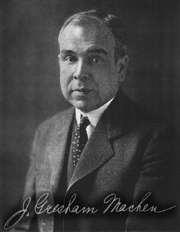
Fundamentalism has greatly--and I mean severely--affected Reformed thinking in America. The Bible--thanks to the fundamentalists--has been reduced to propositional statements about God and most American Christians read their Bibles in an ahistorical fashion. Scholars in this camp have no problem with the study of history per se, but to read the Bible as an historical document is seen as a "liberal" endeavor. But much of the reformed world in America would have no problem allying itself with the great founder of Twentieth-Century reformed thinking, J. Gresham Machen. But what does Machen himself believe?
The student of the New Testament should be primarily an historian. The centre and core of the Bible is history. Everything else that the Bible contains is fitted into an historical framework and leads to an historical climax.
...
Give up history, and you can retain some things. You can retain a belief in God. But philosophical theism has never been a powerful force in the world. You can retain a lofty ethical ideal. But be perfectly clear about one point--you can never retain a gospel. For gospel means 'good news', tidings, information about something that has happened. A gospel independent of history is simply a contradiction in terms.
Could it be any clearer?
Subscribe to:
Posts (Atom)